The IUCN recently posted an article about "invasive aliens." No, these are not the type found in summer movies like Super 8
 . These are the species - animal and plant - that invade habitats where they do not belong.
Biodiversity is being lost at an unprecedented rate, with a whole host of factors contributing to the disastrous declines. Habitat destruction is well-documented as being one of the leading causes of species extinctions, but invasive alien species are also to blame. But what exactly is an invasive species? Invasive species are those organisms which have been introduced by man, either accidentally or on purpose, to areas in which they are not naturally found, and have thrived to the extent that they have taken over their new environment.
It is important, however, to make the distinction between these species and ‘non-native’ species. Plenty of species are introduced to areas outside of their natural range, and are hence non-native, but not all of these will become invasive. Many will not be able to adapt to the new environment at all, and may eventually die off. Other non-native species cope well in their new surroundings without ousting native species from the ecosystem, co-existing without competition. An ecosystem can support this change as its original components and key players are still there. The non-native species may itself prove beneficial to human wellbeing and in some cases may become part of the landscape, as in the case of the Mediterranean Cypress (Cupressus sempervirens) in Tuscany or the Common Pheasant (Phasianus colchicus) in many areas of North America and Europe. What causes a species to be labelled as invasive rather than simply non-native is its ability to out-compete native species, impacting on the biological diversity of the region and even on the livelihoods of human communities.
 |
| Stink Bug via http://media.nj.com/hunterdonnews_impact/ |
Invasive species in New Jersey include foreign bugs, plants, animals and aquatic creatures. Invasive species are introduced species that can thrive in areas beyond their natural range. They are characteristically very adaptable, aggressive, and have a high reproductive capacity. Their vigor combined with a lack of natural enemies often leads to outbreak populations that threaten and endanger native species.
For example, the East Asian stink bug is in NJ now and does literally stink.
The European green crab and the Asian Shore Crab threaten our native acquatic populations.
 |
| Flathead Catfish caught in the Delaware River near Lambertville blogs.courierpostonline.com |
 |
| Giant Hogweed flower head |
Last fall, the first North American instance of invasive Chinese pond mussel was confirmed by New Jersey state biologists in Hunterdon County after DNA testing.
The USDA's website offers state lists and news. For NJ information, see invasivespeciesinfo.gov/unitedstates/nj.shtml
Further Reading


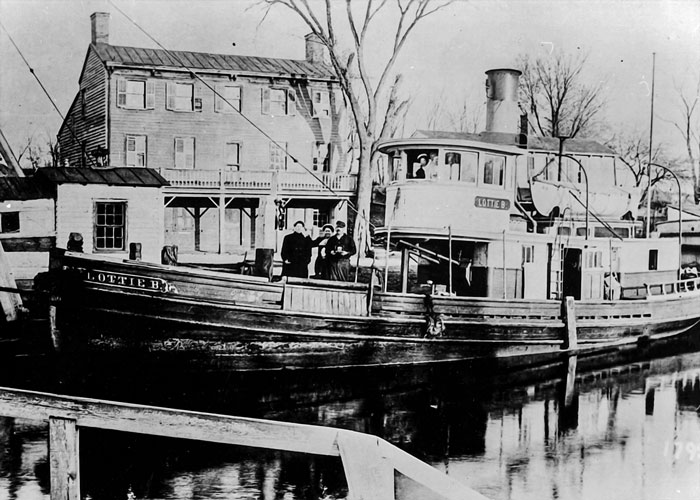
 It was intended as an efficient and reliable means of transportation of freight between Philadelphia, Pennsylvania and New York City, especially coal from the anthracite coal fields in eastern Pennsylvania. Before the advent of the railroads, the canal allowed shippers to cut many miles off the traditional route from the Pennsylvania coal fields. That route took the coal down the Delaware, into the Atlantic Ocean, around Cape May, and up along the coast to New York City.
 The canal system was dug mostly by hand tools, mostly by Irish immigrants. Work began in 1830 and was completed in 1834, at an estimated cost of $2,830,000. When the canal first opened, teams of mules were used to tow canal boats through it (the steam engine was not yet applied to such uses).