Showing posts with label Barnegat Bay. Show all posts

Wednesday, March 30, 2022

The Osprey Cam at Long Beach Island

We posted earlier this week about the Conserve Wildlife Foundation of NJ peregrine falcon camera in Elizabeth, NJ, and today we feature their Barnegat Light Osprey Cam. 

The camera at this tall nest gives us a look at this third year for this pair of ospreys at this nest site (second year of cam).  

In 2018, they produced two young, three in 2019, and three in 2020. All young have been banded for future tracking. 

The osprey (Pandion haliaetus carolinensis) is a large bird of prey, which is sometimes referred to as a “fish hawk.” They are found in open areas and nest near water, where they find their main food source, fish. In New Jersey, most ospreys nest along the Atlantic Coast from Sandy Hook to Cape May and then west along the Delaware Bayshore to Salem with less frequent nests along the Delaware River and in Northern Jersey.

Their website states that "ospreys are an important bioindicator species and reflect the health of their surrounding environment. A healthy coastal ecosystem equals a booming shore economy and the ospreys indicate that we're doing a good job of protecting our coastal areas. There are still many threats to ospreys, even though they have recovered from the effects of DDT and habitat loss."

You can help too.
Reduce your dependence on single-use plastics.
Purchase sustainable/local caught seafood.
Don't release balloons which often end up in waterways and mimic food.
Join in a coastal cleanup and
pick up plastic litter that you see near the ocean and waterways.


You can also check out the weather at Barnegat Light at their weather station.

And you can donate to the Foundation to help them continue
to conserve wildlife and educate in New Jersey.

Saturday, July 21, 2018

Advisory on Clinging Jellyfish in Barnegat Bay


Clinging jellyfish, a nonnative species with a powerful sting, have been confirmed in the north-central region of Barnegat Bay, prompting the Department of Environmental Protection to expand a recreational-use advisory to the entire bay.

The advisory follows advisories the DEP previously issued for recreational users of northern Barnegat Bay, the Metedeconk River in Ocean County and the Shrewsbury and Manasquan rivers in Monmouth County.

About 40 clinging jellyfish were confirmed in north-central Barnegat Bay on Monday – at Jonny Allens Cove on the bayside of Island Beach State Park and in eelgrass beds on the north side of Tices Shoal, a popular boating and watercraft area on the bay side of the park.

The jellyfish collected in both areas were in varying stages of maturation.

The clinging jellyfish is not known to inhabit ocean beaches or other sandy areas but tends to attach itself to submerged sea grass and algae in back bays and estuaries, areas not heavily used for swimming.

Recreational users of the bay, including those using the popular Tices Shoal area, are advised to be vigilant to the possible presence of clinging jellyfish. Clinging jellyfish stings can produce severe pain, muscle cramping and other localized symptoms. In some individuals, stings can result in hospitalization.

In Barnegat Bay, beds of sea grass can provide ideal habitat for clinging jellyfish, which are very small and hard to see in the water. The clinging jellyfish ranges from the size of a dime to about the size of a quarter. It has a distinctive red, orange or violet cross across its middle.

The DEP encourages the public to use common sense and caution in areas where jellyfish are suspected. Anyone wading through these areas, especially near sea grass, should wear boots or waders to protect themselves.

The clinging jellyfish was first confirmed in New Jersey in 2016 in the Manasquan River at the Point Pleasant Canal. The DEP is working in partnership with Montclair State University to continue clinging jellyfish surveys in the bay.

If stung by a clinging jellyfish:

  1. Apply white vinegar to the affected area to immobilize any remaining stinging cells.
  2. Rinse the area with salt water and remove any remaining tentacle materials using gloves or a thick towel.
  3. A hot compress or cold pack can then be applied to alleviate pain.
  4. If symptoms persist or pain increases instead of subsiding, seek prompt medical attention.

People are advised against trying to capture clinging jellyfish. Take a photograph if possible and send it to Dr. Paul Bologna at bolognap@mail.montclair.edu or Joseph Bilinski at joseph.bilinski@dep.nj.gov along with location information.

For a fact sheet on clinging jellyfish, visit www.nj.gov/dep/docs/clinging-jellyfish-factsheet.pdf

For a PowerPoint presentation on DEP clinging jellyfish research, visit www.nj.gov/dep/docs/clinging-jellyfish-distribution.pdf

SOURCE https://www.nj.gov/dep/newsrel/2018/18_0059.htm

Monday, April 23, 2018

Sedge Island Summer Field Experience

banner-kayak

Did you know that the bay area around the Sedge Islands is the state's only Marine Conservation Zone? 

Sedge Island is a very unique and pristine salt marsh ecosystem that is home to a variety of wildlife, including the state's most densely populated colony of nesting ospreys (a state-threatened species).

Sedge Island is located just off of Island Beach State Park in the Barnegat Bay.

Summer programs for adults and children at Sedge Island are offered by the Conserve Wildlife Foundation of NJ, our partner in many management, research and educational programs. Programs range from fishing to kayaking to professional development workshops for teachers.  To learn more, visit the CWF's Sedge Island Summer Field Experiences page.

Saturday, July 2, 2016

Green Navigation


Press Release: DEP Promotes Environmentally Friendly Trips for Boating Through Ecologically Sensitive Areas of Barnegat Bay

The Department of Environmental Protection is asking boaters to be cautious this summer as they navigate a number of ecologically sensitive areas of Barnegat Bay.

Reducing the impacts from boating and the use of personal watercraft to the most critical areas of the bay’s ecosystems is part of the Christie Administration’s comprehensive efforts to protect and restore the bay.

“The reduction of watercraft impacts helps protect the environmentally sensitive ecosystems of the bay, including wetlands, shellfish and fish habitats and aquatic vegetation,” said DEP Commissioner Bob Martin. “It is especially important that we work with the boating community to help protect and maintain this environmental treasure, which offers such a wealth of recreation and tourism opportunities for New Jersey residents and visitors.”

Boaters can access an online interactive map on mobile devices and computers to find the locations of 16 designated ecologically sensitive zones of Barnegat Bay. The maps can also show the locations for marinas, sewage pump-out facilities, bait and tackle shops, launches and ramps, restrooms, and places to dispose of trash.

The map may be found at www.nj.gov/dep/barnegatbay/plan-watercraft-map.htm

New Jersey’s boating and fishing industries also are involved in the effort to promote ‘green’ boating.

“Recreational marine businesses, especially marinas, depend heavily on clean water and a healthy boating environment,” said Melissa Danko, Executive Director of the Marine Trades Association of New Jersey. “As an industry, we work hard every day to preserve our natural resources and encourage boaters to do their part when out on the water and to be aware of their actions and impacts at all times. By working together, we will be able help protect our natural resources not only for this generation but for generations to come.”

The 75-mile environmentally sensitive estuarine system of Barnegat Bay is home to plants, fish and other wildlife. It contains submerged aquatic vegetation that serves as nursery grounds for fish and wildlife. Motor boat propellers and turbulence caused by boat wakes can disturb and harm these sensitive areas.

To help maintain the vibrancy of Barnegat Bay, DEP encourages boaters to follow these guidelines:


  • Stay out of restricted areas set aside for wildlife
  • Do not harass nesting birds and other animals
  • Maintain a 100-foot distance from natural shorelines
  • Minimize wakes in all shallow areas to help reduce erosion and harm to aquatic animals and plants
  • Buoy mooring chains and lines to prevent them from scraping the bay’s bottom and harming submerged aquatic vegetation
  • Appreciate wildlife from a distance
  • Reduce air pollution by not idling in open water


To learn more about environmentally conscious boating, and reducing impact to Barnegat Bay and other state waterways, visit: www.nj.gov/dep/barnegatbay/docs/BoaterESA.pdf

For clean boating tip sheets available to boaters through the Clean Marian Program, visit: www.nj.gov/dep/njcleanmarina/boaters.htm

For more information about the Christie Administration’s Barnegat Bay Action Plan, visit: www.nj.gov/dep/barnegatbay/

Monday, January 14, 2013

Reopening Shellfish Beds in NJ After Hurricane Sandy

The Department of Environmental Protection has continued to reopen shellfish beds that they had closed to commercial and recreational harvesting on October 29, 2012 in preparation for Hurricane Sandy. The closing was because of concerns over the degradation of coastal water quality from the storm.

Shellfish is both a culinary and fisheries term for exoskeleton-bearing aquatic invertebrates used as food. This includes various species of mollusks, crustaceans, and echinoderms.

Although most kinds of shellfish are harvested from saltwater environments, some kinds are found only in freshwater.

Despite the name, shellfish are not a kind of fish, but are simply animals that live in water. Many varieties of shellfish (crustaceans in particular) are actually closely related to insects and arachnids, making up one of the main classes of the phylum Arthropoda.

Cephalopods (squid, octopus, cuttlefish) and bivalves (clams, oysters) are mollusks (or molluscs), as are snails and slugs.

Quahogs are a hard clam familiar yo New Jerseyeans. They are found in estuaries
where the water is relatively warm and salt water mingles with fresh.
Quahog (ko-hog) is from the Narragansett Indians' word for the clams, "poquauhock."
These are the shells they used to carve the purple and white wampum beads used for trading.

At our tables, we are likely to see clams, mussels, oysters, and scallops. Popular crustaceans at the dinner table are shrimp, lobster, crayfish, and crabs. Echinoderms are not as frequently harvested for food as molluscs and crustaceans, however sea urchin roe is quite popular in many parts of the world.

Beds in the Raritan Bay remain closed until further notice due to intermittent bypasses of temporary pumps at the Sayreville pump station in the Raritan River resulting from storm damage from Hurricane Sandy. The DEP is continuing to monitor water quality and shellfish tissue, and will reopen shellfish beds in the remaining closed areas when monitoring and sampling criteria are met.

In late December, the northern end of Barnegat Bay was reopened following water monitoring and tissue sampling that found no issues with contamination from bacteria or viruses as a result of the storm. The area of Barnegat Bay reopened for shellfish harvesting is north of the Mathis Bridge, also known as the Route 37 Bridge, in Toms River.

Earlier on November 11, the DEP reopened shellfish beds in Delaware Bay from Lower Alloways Creek south to Cape May Point. On November 14, the DEP reopened shellfish beds in Atlantic coastal waters from Little Egg Inlet south to Cape May Point. On Dec. 7, the shellfish beds in the Navesink and Shrewsbury rivers in Monmouth County were reopened, followed by the reopening of the beds in Sandy Hook Bay on Dec. 14


More information and a map of reopened shellfish beds nj.gov/dep/wms/bmw/sandy.html.

Wednesday, May 30, 2012

Want To Be A Spill Spotter?


I can't believe that it has been two years since the BP oil spill in the Gulf of Mexico. When that happened, there was even talk that if it wasn't capped some of the oil would be making it up the Atlantic coast to NJ waters.

NJ doesn't allow offshore drilling currently. But the Delaware and Raritan bays are very active ports and our oil refineries bring tankers in loading and unloading petroleum and other chemicals. So, NJ is vulnerable and should be prepared.

The American Littoral Society has a "Spill Spotters" program in which they train volunteer citizens and community groups to recognize and respond to signs of an oil spill.

I only just became aware of the program via the NJ Conservation blog and the first of the three-hour workshops just took place on Delaware Bay, Barnegat Bay and on Raritan Bay.

But more are planned over the summer and The Littoral Society is looking for individuals, as well as teachers, scout leaders and other community activists who can, in turn, pass the knowledge on to those interested in coastal protection. The workshops are active learning with seine nets, clam rakes and binoculars. Participants learn to how to collect baseline data on birds, fish, crustaceans, mollusks, worms and other creatures living in and around coastal waters, since knowing the normal background conditions will help them detect problems in the future.

Individuals and groups can then "adopt" spots along bays or estuaries, collect biological data with the help of American Littoral Society staff members. It's a good volunteer opportunity and a great way to learn more about your local waterways.

The Spill Spotters use an oil spill response toolkit and have information for reporting problems, but their job is not remediation (such as caring for oil-soaked birds) although they can get that training too if they're interested.

For more information about the Spill Spotters program and to find a workshop near you, visit www.spillspotters.net or contact Stevie Thorsen at Stevie@littoralsociety.org or 732-291-0055.

Tuesday, December 14, 2010

NJ Passes Clean Water Bills

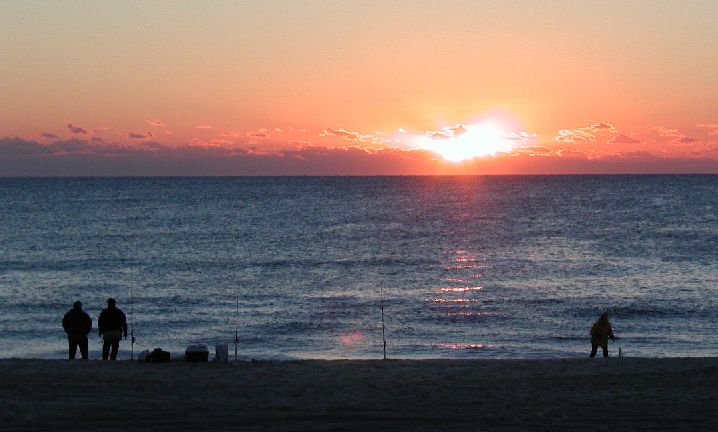
Fishing at Island Beach State Park (NJDEP)

The NJ Legislature passed a bill yesterday giving New Jersey the most restrictive standards on fertilizer in the nation.

The bill, which Governor Christie has already pledged to sign, is designed to reduce the amount of nitrogen that can wash into the state’s bays, lakes and rivers.

It restricts the nitrogen content of fertilizers and also sets limits on when homeowners and contractors can spread fertilizer on lawns. Unfortunately, golf courses are exempt from the new rules.

A package of other bills related to Barnegat Bay also passed the Assembly and should come up for a state Senate vote next Monday, sponsors say.

A compromise (after more than a year of negotiations) led to the requirement that all fertilizers contain at least 20 percent slow-release nitrogen. 30 percent was desired by environmental groups and 15 percent was the amount set by fertilizer manufacturer Scotts Miracle-Gro and Rutgers turf-grass experts.

Nitrogen is the focus because it often gets washed by rains into the state’s bays and other water bodies. It provides nutrients for algae and other aquatic plants that can grow so quickly they reduce oxygen levels in the water, threatening fish and other wildlife.

The heaviest blooms also cut off sunlight to the sea grasses that provide protective habitat to marine animals and prevent marsh erosion.

This growth can also hinder recreational boating and swimming in some waters.

How does it affect you directly?

Homeowners will be banned from applying fertilizer between Nov. 15 and March 1 and whenever the ground is frozen. In a similar vein, fertilizer can’t be used within 10 feet of any water body or just before a heavy rainfall. Professionals will be barred from applying fertilizer between Dec. 1 and March 1.

The legislation also bans the use of phosphorus in fertilizer to protect fresh water bodies such as lakes and streams. Some fertilizer manufacturers already have products that meet or exceed the standards set by the legislation.Those that do not will have one year from the bill’s implementation to comply.

The New Jersey Sierra Club applauded the legislation and noted its importance in protecting drinking water and the coastal tourism industry.