Tuesday, February 27, 2018

Repairing Beaches on LBI

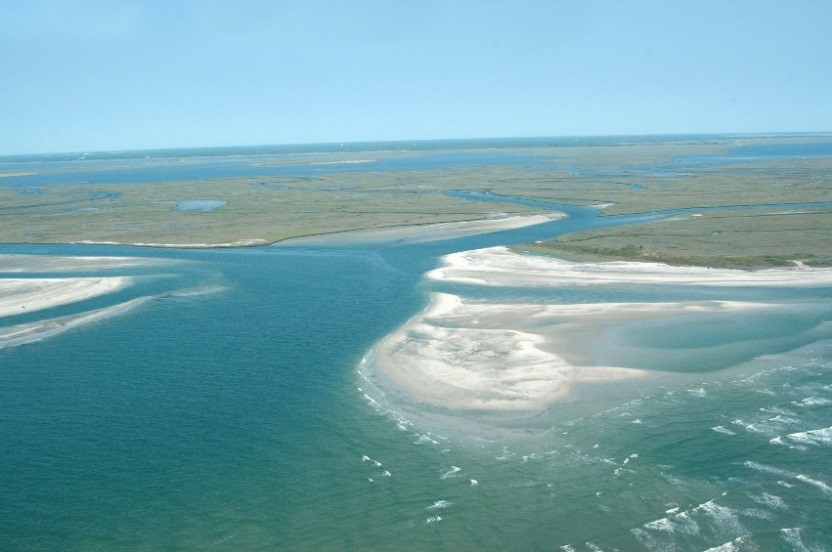
DEP PHOTO Little Egg Inlet
The Department of Environmental Protection’s Division of Coastal Engineering has launched a major project utilizing sand dredged to create a safe boat channel for Little Egg Inlet to repair beaches and dunes on southern Long Beach Island that have sustained significant erosion from storms.

“This project is designed to have the multiple benefits of restoring beaches that are economically vital for shore tourism and storm protection while making it safe for boaters to again use Little Egg Inlet,” said David Rosenblatt, DEP’s Assistant Commissioner for Engineering and Construction. “We look forward to having the project completed in time for the next tourism and boating season.”

Oak Brook, Ill.-based Great Lakes Dock and Dredge Co. on Jan. 18 launched the $18.4 million project that is utilizing sand from the southern portion of the inlet to repair beaches and dunes in Holgate and Beach Haven. The inlet is a major thoroughfare for recreational and commercial fishing boats between southern Long Beach Island and Brigantine. The project is funded by the DEP’s Shore Protection program.

The DEP is also partnering with the U.S. Army Corps of Engineers and Brigantine to pump 755,000 cubic yards of sand from the much smaller Brigantine Inlet, south of Little Egg Inlet, to repair beaches and dunes in that city that were damaged by a nor’easter in January 2016. The project began Jan. 19. Brigantine Inlet is not a navigation channel but has accumulated large shoals that can be utilized as a “borrow” area to provide sand for beaches and dunes.

Cranford-based Weeks Marine is implementing this $10.6 million project for the Army Corps of Engineers, which is providing $9.8 million in funding. The project will repair beaches and dunes from north of 14th Street south to Roosevelt Avenue. The DEP and city are cost-sharing the balance.
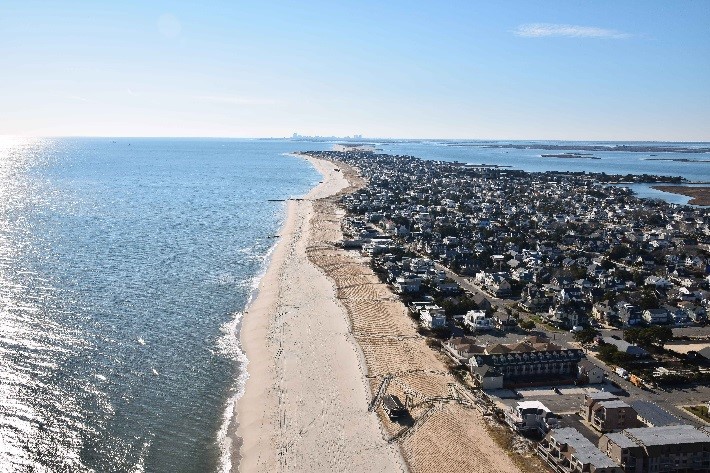
DEP PHOTO - Southern LBI project area
The much larger Little Egg Inlet is one of the widest inlets in New Jersey, and is extremely dynamic with shoals constantly shifting with the seasons. It provides access to the Little Egg Harbor portion of Barnegat Bay and Great Bay.

The channel has never been dredged. Over the years, the Coast Guard would mark the safest natural channel through the inlet. In March 2017, the Coast Guard removed navigational buoys because shoaling was so severe that no safe channel could be marked.

The Little Egg Inlet project will clear a mile-long portion of the previously marked channel that is 24 feet below mean sea level, using this sand to restore beaches in Beach Haven and Holgate on Long Beach Island. The Dredge Texas is working in conjunction with two large booster pumps to pump sand onto beaches.

Sand replacement work began near Susan Avenue in Holgate and is working north toward Beach Haven. Work has progressed to the area near Jeffries Avenue in Beach Haven. Work in Beach Haven will take about two more weeks, depending on weather.

Upon completion of work in Beach Haven, the dredge will begin operations near Rosemma Avenue in the Holgate section of Long Beach Township and will work southward to the Forsythe National Wildlife Refuge border. Pumping in this section should take about three weeks.

Depending on weather, the expectation is that all work and demobilization will be completed by mid-March. In total, some 700,000 cubic yards of sand will be moved from the inlet to the beaches, with an option to move an additional 300,000 cubic yards if necessary.

Each of the municipalities will be re-establishing sand fences, crossovers, and dune grass once the contract work and demobilization is completed.

Source: NJDEP - News Release 18/P008

Tuesday, February 13, 2018

Is Chocolate Endangered?


Valentine's Day is a big day for chocolate. The ancient Mayans said it was the food of the gods. In the 19th century, it was considered an aphrodisiac. This past Valentine's Day, Americans spent an estimated $1.7 billion on chocolate. Globally, it is a $98 billion a year product.

Consumer demand for chocolate is on the rise. But the cacao tree, the seeds of which yield cocoa powder, is threatened by pests, fungal infections and climate change.

A New Jersey connection comes to us via Mars Wrigley Confectionary. This $35 billion corporation needs chocolate and knows about the problems connected to it.  Last September, the company pledged $1 billion as part of an effort called "Sustainability in a Generation," which aims to reduce the carbon footprint of its business and supply chain by more than 60% by 2050.

The chocolate company behind M&M's, Snickers, and Twix, is expanding in New Jersey. The company announced that it will open its U.S. headquarters in NJ. The HQ will have two locations, one in their existing offices in Hackettstown, and another in a new space in Newark that will bring about 500 jobs to the city when it is up and running by July 2020.

Chocolate is made from Theobroma cacao seeds, roasted and ground. Theobroma cacao, also called the cacao tree and the cocoa tree, is a small evergreen tree native to the deep tropical regions of Central and South America. Its seeds, cocoa beans, are used to make cocoa mass, cocoa powder, confectionery, ganache and chocolate.

Researchers are working on multiple approaches that could bolster the fragile tree. The pests and diseases to which cacao is subject, along with climate change, mean that new varieties will be needed to respond to these challenges. Breeders rely on the genetic diversity conserved in field genebanks to create new varieties, because cacao has recalcitrant seeds that cannot be stored in a conventional genebank.

Wednesday, February 7, 2018

Oceanic Whitetip Shark Classified As Threatened


Oceanic Whitetip Shark with Pilot Fish - Photo: By The original uploader was OldakQuill at English Wikipedia - Transferred from en.wikipedia to Commons., CC BY-SA 3.0, Link

The federal government says the oceanic whitetip shark will be listed as threatened under the Endangered Species Act to help the species recover. The shark lives along the East Coast of the United States, off southern California and in international waters. Conservation group Defenders of Wildlife called on the government to list the species.

The oceanic whitetip shark (Carcharhinus longimanus), also known as Brown Milbert's sand bar shark, brown shark, nigano shark, oceanic white-tipped whaler, and silvertip shark, is a large pelagic requiem shark inhabiting tropical and warm temperate seas. Its stocky body is most notable for its long, white-tipped, rounded fins. Scientists say the sharks have declined by 80 to 90 percent in the Pacific Ocean since the 1990s and they have fallen 50 percent to 85 percent in the Atlantic Ocean since the 1950s.

Conservationists blame commercial fishing and demand for their fins. Their large fins are highly valued as the chief ingredient of shark fin soup, and as with other shark species, the whitetip faces mounting fishing pressure throughout its range.

This slow-moving but aggressive fish dominates feeding frenzies, and is a danger to shipwreck or air crash survivors.

Wednesday, January 31, 2018

Hackettstown State Fish Hatchery Stocked a Record 5 Million Fish in 2017

The Hackettstown State Fish Hatchery in Warren County stocked a record five million cold, cool, and warm water fish consisting of 15 species in 2017, Department of Environmental Protection Commissioner Bob Martin announced today.

The fish, totaling 5,082,841 with a total weight of more than 26,000 pounds, were produced at the location and many were stocked in approximately 200 waters throughout the state from March through November.

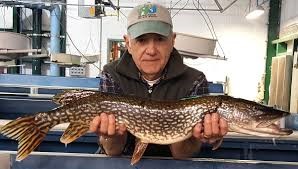
Fishery staff with Northern Pike
“This is an incredible achievement by our staff at the Hatchery,” said Commissioner Martin. “Anglers are reporting catching 40-inch Northern pike, 10-pound walleyes, and 50-inch muskellunge in many of our waters where these species are stocked. It is through the Hatchery’s staff and their hard work that New Jersey is a world class fishing destination for anglers.”

Those five million plus fish included cool water species such as Northern Pike, Walleye, and Muskellunge. Hackettstown stocked 308,808 Northern pike, 2.3 million walleye, and 343,311 muskellunge for New Jersey anglers.

The season also included strong year classes of warm water species such as channel catfish – 598,174, largemouth bass – 110,445, and hybrid striped bass – 47,315. These three species are providing excellent, exciting recreation for anglers throughout the state.

Not all the Hackettstown fish stocked are directly available to anglers, however. County mosquito commissions utilized 548,000 fathead minnows, and Gambusia (commonly called mosquitofish) to combat mosquito larvae in stagnant waters. Since 1991, the hatchery has reared more than 5.6 million fish to help combat mosquito borne diseases such as West Nile Virus, Eastern Equine Encephalitis and Chikungunya.

In addition, 655,000 golden shiners were stocked in Round Valley Reservoir to help boost the forage base in one of New Jerseys best cold water fisheries. The hatchery has stocked more than 1.5 million shiners in Round Valley over the past five years.

In addition, some 171,788 fish of other species were raised in 2017 setting the facility’s new yearly production record at 5,082,841, far surpassing the previous high of 3,774,885 set in 2014.

Some of the many factors that contributed to a great season included the successful collection of broodstock and their eggs, an excellent hatch and extensive on-site pond management. Modern fish diets and nutrition also played important roles, as well as ideal temperatures, sunlight and precipitation for adequate growth, proper health monitoring and avoiding the hazards of overcrowding.

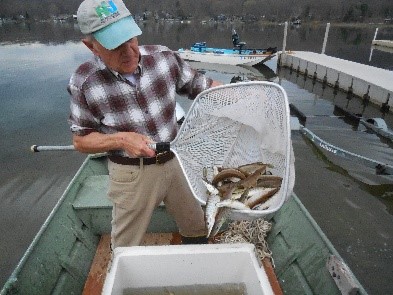
Fishery staff handling fingerlings at Hackettstown
The Hackettstown State Fish Hatchery opened in 1912 and is predominantly a put, grow, and take fish culture operation. This simply means that most of the fish are stocked as sub-legal fry and fingerlings that will take a year or more growing in the wild to reach a catchable size. The fish-rearing operation requires a combination of intensive fish culturing both indoors in fiberglass tanks and outdoors in earthen ponds.

“The Hackettstown Hatchery has stocked nearly 20 million cool and warm water fish over the past five years,” said Division of Fish and Wildlife Director Larry Herrighty. “Staff take immense pride in the quality of fish produced at the hatchery and constantly strive to find ways to improve both hatchery operations and the number of fish produced. This is a great way to conclude the celebration of our agency’s 125th anniversary and I commend our staff at Hackettstown for a job well done.”

Funding for operations at the Hackettstown State Fish Hatchery is provided by anglers through fees derived from the purchase of fishing licenses and by the Federal Aid in Sportfish Restoration program.

More information about the Hackettstown State Fish Hatchery,
including its history, feature articles, species raised and stocking summaries can be found at state.nj.us/dep/fgw/hacktown.htm

Source: http://www.nj.gov/dep/newsrel/2018/18_0003.htm