Friday, July 30, 2010

Lyme Disease


Lyme disease is a bacterial infection that is spread to people by the bite of infected ticks. It is prevalent in New Jersey. At one time, it was a disease associated with people who spent time in the woods - hikers, birders, campers, hunters,and  fisherman. However, now, 35 years after it was first identified, you are just as likely to get it in areas that are less than wilderness and that may not even be rural.

Lyme disease can cause a rash, flu-like symptoms, and aching joints. It can be treated with antibiotics, but without treatment, Lyme disease can cause serious, long-term health problems.


Lyme disease gets its name from the town of Lyme, Connecticut, where the illness was first identified in the United States in 1975.

It is caused by a corkscrew-shaped bacterium, or spirochete, called Borrelia burgdorferi. Ticks infected with the bacterium spread the disease to humans. In the Northeast and Great Lakes region, Lyme disease is spread by the black-legged tick, which lives in wooded areas, grasslands, and yards. In the Pacific Northwest, the disease is spread by the western black-legged tick. In the Southeast, the disease is thought to be spread by the black-legged tick.

Cases of Lyme disease have been reported by nearly every state in the United States, but the disease is concentrated in the east coastal states, the north central states, and northern California. Connecticut, Rhode Island, New York, New Jersey, Delaware, Pennsylvania, Maryland, and Wisconsin account for about 90% of all cases.

Ticks become infected with the Lyme disease bacterium by feeding on infected animals, such as mice, chipmunks, and other wild rodents. Lyme disease is passed to humans and other animals when a tick infected with the bacterium bites the person or animal and stays attached long enough (usually more than 36 hours) to take a blood meal.

The tick that spreads Lyme disease has a 2-year life cycle, and feeds once in each of its three life stages -- larvae, nymph, and adult.

Though we tend to blame deer for the spread of the disease (especially in suburban areas), in the tick's larvae stage, it is tan, the size of a pinhead, and feeds on small animals like mice.

During the nymph stage, the tick is the size of a poppy seed, beige or partially transparent, and feeds on larger animals such as cats, dogs, and humans.

Adult ticks are black and/or reddish and feed on large mammals such as deer, dogs, and humans.

Signs and symptoms of Lyme disease
  • Tiredness
  • Chills and fever
  • Headache
  • Muscle and/or joint pain
  • Swollen lymph glands
  • A characteristic skin rash, called erythema migrans, that is a red circular patch about 2 inches in diameter that appears and expands around the site of the tick bite. The center may clear as it enlarges, resulting in a "bulls-eye" appearance. The rash may be warm, but it usually is not painful or itchy.
Unfortunately, some infected people do not recognize the early symptoms and are diagnosed only after complications occur.

Those complications include:
  • Arthritis (swelling and pain) in the large joints, which can recur over many years
  • Nervous system problems, such as numbness, meningitis (fever, stiff neck, and severe headache), and Bell's palsy (paralysis of the facial muscles, usually on one side)
  • Irregularities of the heart rhythm

Lyme disease is diagnosed by a physical examination and medical history. The clinical diagnosis is supported by laboratory testing. Unfortunately, the diagnosis of Lyme disease can be difficult. Current tests are not completely accurate, and the symptoms can mimic those of other diseases. Diagnosis is easiest when there is a skin rash.

Lyme disease is treatable with antibiotics taken for 3 to 4 weeks. More difficult cases may require longer treatment and combinations of drugs. Re-infection from tick bites is possible after treatment.

A Lyme disease vaccine is under development but is not yet available. The only sure way to prevent the disease is to avoid exposure to infected ticks. Especially avoid areas where wild mice might live, such as the edges of yards, fields, and woods with low, dense groundcover.

During outside activities, wear long sleeves and long pants tucked into socks. Wear a hat, and tie hair back.

SAWYER® PREMIUM CLOTHING INSECT REPELLENT 24 oz Trigger Spray
Use insecticides to repel or kill ticks. Repellents containing the compound DEET can be used on exposed skin except for the face, but they do not kill ticks and are not 100% effective in discouraging ticks from biting. Products containing permethrin kill ticks, but they cannot be used on the skin -- only on clothing. When using any of these chemicals, follow label directions carefully. Be especially cautious when using them on children.

After outdoor activities, check yourself for ticks, and have a "buddy" check you, too. Check body areas where ticks are commonly found: behind the knees, between the fingers and toes, under the arms, in and behind the ears, and on the neck, hairline, and top of the head. Check places where clothing presses on the skin.

Remove attached ticks promptly. Removing a tick before it has been attached for more than 24 hours greatly reduces the risk of infection. Use tweezers, and grab as closely to the skin as possible. Do not try to remove ticks by squeezing them, coating them with petroleum jelly, or burning them with a match.
 
The large brown ticks that are commonly found on dogs and cattle do not carry the Lyme disease bacterium. If you remove a very small tick and want to have it tested for Lyme disease
, place it in a clean pill vial or tight-sealed plastic storage bag with a moistened cotton swab. Contact your health-care provider and local health department.


http://www.dhpe.org/infect/Lyme.html
Healing Lyme: Natural Healing And Prevention of Lyme Borreliosis And Its Coinfections
The Top 10 Lyme Disease Treatments: Defeat Lyme Disease with the Best of Conventional and Alternative Medicine
Cure Unknown: Inside the Lyme Epidemic

Monday, July 26, 2010

Renaming Endangered Species

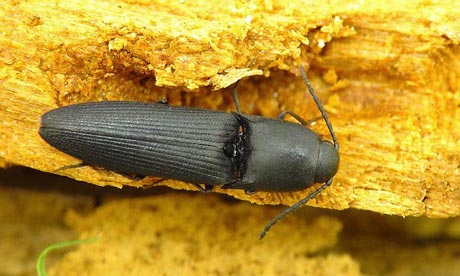
The Queen's Executioner  via http://static.guim.co.uk
Can giving endangered species more common English names help save them? That was the idea behind the Oxford University Museum of Natural History’s "Name a Species" competition.

Would you be more interested in and more likely to remember a beetle if it was named megapenthes lugens or if it was called the Queen’s executioner?

The competition invited the public to give popular names to ten species of endangered British beetle, bees, jellyfish, shrimps and lichens. The competition itself was one way to get people thinking about the species, and perhaps they will be more familiar.

Among the winning names picked from the three thousand entries received were:
  • skeetle, a beetle that escapes predators using natural ‘jet skis’  stenus longitarsis
  • sea piglet, a deep-sea ‘pseudo shrimp’  arrhis phylonyx
  • kaleidoscope jellyfish, which is a beautiful stalked jellyfish
  • St John’s jellyfish, which takes the shape of a Maltese cross
  • Mab’s lantern, a rare spotted beetle
  • cuckoo bee, which lays its eggs in the nest of other bees
  • blue pepper-pot beetle, whose larvae live in willow trees
  • witches’ whiskers lichen, which have medicinal properties
  • pixie gowns lichen, which turn green when wet
  • And, the overall winner is the Queen’s executioner, a beetle found only in Windsor Great Park megapenthes lugens. The common name's creator, in a statement accompanying his entry, gave the following rationale for his choice of name: "I've gone with this for the link to Windsor and the royals. The executioner is to represent that it kills (and eats) the larvae of others and also links to its black colour (the hood of an executioner is traditionally black)."[10]

Source: http://www.ox.ac.uk/media/news_stories/2010/100720_1.html

Friday, July 23, 2010

Allaire State Park and Allaire Village

One of NJ's living history museums is Allaire Village. Lving history was a concept that became popular in the late 1960s. The idea is to let visitors see a historic site populated with people who dress and interact like the people of the historical period. Typically, the workers dress in period costumes and demonstrate the crafts and activities of the past.

Colonial Williamsburg is the major living history site on the East Coast, but we have sites in NJ that make good day trips.


 The Historic Village at Allaire is a non-profit,living history museum set in the year 1836. It is located within Allaire State Park in Wall Township, New Jersey. The village was originally established as a bog iron furnace known as the Howell Works, which the company's owner, philanthropist James P. Allaire, endeavoured to turn into a self-contained community.

Allaire Village and its existing buildings are now operated by a non-profit organization Historic interpreters work using period tools and equipment in the blacksmith, tinsmith, and carpentry shops, while the old bakery sells cookies, and general store serves as a museum store.

The company town that developed in the early 1800s around the Howell Works, made brass fittings for ships. A New York City businessman bought a large piece of land in Monmouth County and turned it into a bog iron works.

Old Village - Allaire State Park Canvas Print / Canvas Art - Artist Angie McKenzie     The Village - Allaire State Park Canvas Print / Canvas Art - Artist Angie McKenzie

Check their calendar of special events.
Directions via Mapquest

Museums in Monmouth County, New Jersey: including Allaire Village
The Deserted Village at Allaire

Wednesday, July 21, 2010

The New Jersey Osprey Project


I recommend that you check out the New Jersey Osprey Project blog done by Ben Wurst. Ben is listed as a Habitat Program Manager in New Gretna, NJ.

The blog has lots of information and some great photos from the field (see examples above and below).

A recent post covered the June start of the first of many osprey surveys which are conducted every year to help determine the overall health of the population.

This is another activity that is mostly done by volunteers who commit many hours of their personal time to helping monitor the bird population.

USGS leg bands are placed on the young which enables scientists to gather valuable data about where ospreys migrate and winter, their survival rates and behavior.


Awesome Ospreys: Fishing Birds of the World

Return of the Osprey: A Season of Flight and Wonder

Tuesday, July 20, 2010

350 Challenge from Brighter Planet

Brighter Planet's 350 Challenge

Endangered New Jersey joined the 350 Challenge. After they hit their goal of 350 participating bloggers in under a month, they decided to keep the 350 Challenge open indefinitely. Now over 3,900 bloggers are participating.

To join in, post the badge to your own site, let them know, and they will offset 350 pounds of carbon in your name. That's like flicking off 100 lightbulbs for a day. Or going two full weeks without your car!

By displaying their badge on our blog, we help offset 122,500 lbs of CO2 - that's like turning off 38,000 light bulbs for a day.

Brighter Planet develops innovative tools to help manage and accelerate the transition to a low-carbon future.

Check out their

"Personal footprint tools"
"Crowd-powered philanthropy"
  • social giving via wowcrowd (in private beta), lets businesses, campaigns, foundations, and other organizations engage their members by allowing them to propose, discuss, and vote on ideas to receive project funding. This service grew out of the viral success of the Project Fund, Brighter Planet's own community-powered monthly grant program for grassroots climate projects.
Brighter Planet recently was named Small Business of the Year by Treehugger and received the Social Innovation Award for "most strategic philanthropy" from Justmeans and Financial Times.

Friday, July 16, 2010

Nature Centers in Bergen County

Nature centers located in densely populated areas may be even more important than those located in rural and wilderness areas. Not only for the protection of habitat and species, these centers are important educational centers and a way for urban and suburban families to stay in touch with the natural world.

Here are three Bergen County, New Jersey nature centers.

Pfister Pond at Tenafly NC

The Tenafly Nature Center is a non-profit member-supported nature preserve that protects almost 400 wooded acres. Since 1961, TNC has nurtured an appreciation for nature, been a leader in open-space preservation and in environmental education for our community in Tenafly, Bergen County, and beyond.

When trails are open, you can hike, bird-watch, observe wildlife, cross-country ski, snow-shoe and ice skate on Pfister's Pond.

http://www.tenaflynaturecenter.org


Autumn at Closter

Closter Nature Center is a beautiful oasis in the middle of suburban Closter, New Jersey, with 136 acres of ponds, brooks, meadows and forests to explore. The center is open to all local residents, providing informative monthly lectures and nature walks for the general public, as well as school or scout groups.

http://www.closternaturecenter.org


The Demarest Nature Center is located in Demarest, and is open to all persons, residents and non-residents alike, every day of the year. In addition to preserving and protecting important open space here in the midst of a large metropolitan area, the center seeks to educate young and old alike as to the beauty of nature and the importance of protecting our environment.


http://www.demarestnaturecenter.org


Wednesday, July 14, 2010

Butterfly Garden Tours in Cape May

NJ Audubon's Nature Center of Cape May Join Naturalist and Butterfly Expert Patricia Sutton for her 19th season of spectacular private butterfly garden tours beginning next weekend.

The tours will take place Friday through Sunday, July 16, 17 and 18 and include the best butterfly gardens throughout Cape May County.

Friday’s tour on July 16 will feature gardens in and near Cape May Point and Cape May City.

Saturday’s tour on July 17 focuses on gardens from North Cape May to Rio Grande, and the final tour on Sunday, July 18 will visit gardens from Goshen to Dennisville and Eldora, including guide Pat Sutton’s own garden in Goshen.

Call the nature center now at 609-898-8848 to reserve your spot and get further details.

Butterfly and Hummingbird Gardens


Want to bring some gentle and beautiful wildlife into your own backyard?

Read "Recommended Plantings to Attract Hummingbirds, Butterflies, & Moths" on the NJ Audubon site and also check out their information on backyard habitats and creating gardens to attract wildlife.


Stokes Hummingbird Book : The Complete Guide to Attracting, Identifying, and Enjoying Hummingbirds


Butterflies in the Garden


Creating a Butterfly Garden

Tuesday, July 13, 2010

130 Acres of Open Space For Hopewell Township


More than 130 acres of fields, woods and stream nestled between Washington Crossing State Park and Baldpate Mountain have been permanently preserved as open space.


The historic Hollystone Property, as it's called, was acquired with the help of D&R Greenway Land Trust May 25, a $2.8 million purchase open space advocates and state and local officials are planning to celebrate next week.


Located off Route 29 in the area of Fiddlers Creek Road, the property links Washington Crossing State Park with Baldpate Mountain, effectively creating an 8-square mile swath of preserved land stretching from Mercer to Hunterdon County.

The property was called a "conservation bonanza," with woodlands that make up a 9,500-acre forest that is home to rare and endangered plants and animals.


read more at http://www.nj.com/mercer/index.ssf/2010/07/hopewell_hails_greenways_unite.html

Monday, July 12, 2010

At least 100 species go extinct every day

National Geographic Rare: Portraits of America's Endangered Species

"At least 100 species go extinct every day."

That's the opening to this video by National Geographic photographer, Joel Sartore. It's a companion to his book, Rare: Portraits of America's Endangered Species and it gives you an appreciation for what we stand to lose if changes aren't made concerning these species.


RARE from Joel Sartore on Vimeo

Friday, July 9, 2010

Passaic River Restoration

Cleaning the riverside of the Passaic River at Lyndhurst. Photo via http://www.pvsc.com

In order to protect and preserve local streams and rivers from water pollution, the Passaic Valley Sewerage Commissioners (PVSC) operate one of the country's largest treatment plants for the wastewaters of northern New Jersey.

In 1998, they created the Passaic River/Newark Bay Restoration Program to promote the recreational and economic uses of Newark Bay, the Passaic River and its tributaries. The Program is comprised of three elements: shoreline clean-ups, floatables removal, and "in-house" clean-ups.

The shoreline clean-up element has been among the most successful programs of its kind in the nation. Beginning in 1998, PVSC began assisting volunteer groups in conducting shoreline clean-ups to remove litter and other debris from along waterways within its service area.

In 2000, PVSC created a department of 15 full-time personnel to conduct larger shoreline clean-ups in addition to those organized by volunteer groups and community agencies. To date, PVSC's Restoration Program has conducted or assisted volunteers in more than 250 shoreline clean-ups that have removed over 1,000 tons of litter and debris from area shorelines.

In 1999, PVSC added floatables removal to the Program, after using state grant monies to purchase an innovative 50-foot surface skimmer vessel. Christened the S.V. Newark Bay, this vessel embarks on daily patrols on the Newark Bay and Passaic River, removing floating debris and litter. In 2001, PVSC added a second, smaller skimmer vessel to its clean-up arsenal, this one to conduct daily patrols in shallow water that had been inaccessible to the larger vessels.

Finally, PVSC conducts "in-house" riverbank clean-ups using the services of its employees. These projects are in response to requests for assistance from local municipal leaders. The crew is deployed to clean and restore specific problem areas within the PVSC service area. The success of the program can be demonstrated in its numbers. Since 1998, PVSC has removed 650 tons of floating matter and over 2,000 tons of shoreline debris.


Want to organize a shoreline clean-up? Contact Bob DeVita, River Restoration Program Manager, at (973) 466-2714.

for more information   http://www.pvsc.com/rr/

Thursday, July 8, 2010

Water Conservation Workshops

After this very hot and dry week, we are all paying a bit more attention to rain and water levels.

Sustainable Jersey™ will be offering a WATER CONSERVATION WORKSHOP to help your municipality conserve water through the implementation of the Water Conservation Ordinance, which is one of the program’s priority actions, and the Water Conservation Education Program. The workshop will be presented in 3 locations throughout the state (northern, central and southern), and a webinar will also be held on the topic.

Water is a critical natural resource that supports essential human activities as well as ecological functions. Shortages can have dangerous and significant implications for public health as well as for the local economy and for ecological integrity. In addition to reduced groundwater recharge from increasing impervious surfaces, demands on New Jersey’s limited water supply due to population growth and development have greatly increased.

WHAT WILL BE COVERED?

Water Conservation Ordinance
A Water Conservation Ordinance can help municipalities curtail unnecessary water waste. The elements of the updated model Water Conservation Ordinance will be discussed in detail and we will be soliciting feedback on the proposed changes.

Water Conservation Education Program
To be successful, water conservation efforts must also include an education program that informs individuals of the need to use water resources in a sustainable manner. Municipal education programs that promote water conservation can serve as a good starting point for a more comprehensive water conservation program.

The Water Conservation Workshop will highlight municipal examples that have achieved water conservation through a variety of education strategies.

Speakers from the NJ Department of Environmental Protection will present an overview of the Water Conservation Ordinance, and Water Conservation Education Action in Sustainable Jersey. Representatives from area municipalities will share municipal examples and talk about their own efforts on this topic. There will be time for Questions and Answers.

To sign up for any of the three workshops visit:
http://tcnj.qualtrics.com//SE?SID=SV_9AyQ39m9VNsxMry

To sign up for the webinar, visit: https://www1.gotomeeting.com/register/838782192

WORKSHOP DATES AND LOCATIONS

SOUTHERN LOCATION: July 21, 2010 from 1:30-3:00 p.m. – Council Chambers, Vineland Municipal Building, 640 E. Wood Street, Vineland, NJ 08360.
Directions: http://www.vinelandcity.org/Directory/directionstovld.PDF

NORTHERN LOCATION: July 27, 2010, 7-8:30 p.m. -- Memorial Meeting Room at the Maplewood Memorial Library, 51 Baker Street, Maplewood, NJ 07040.
Directions: http://www.maplewoodlibrary.org/direct.html

CENTRAL LOCATION: July 29, 2010 – 9-11:30 a.m. - Belmar (Courtroom), 601 Main Street, Belmar, NJ 07719. Directions: http://belmar.com/municipal/municipal-court/directions-to-the-court/
WEBINAR: August 3, 2010, from 7-8:00 p.m. Sign up: https://www1.gotomeeting.com/register/838782192

Wednesday, July 7, 2010

Geological Hike at Haney's Mill

View of the Delaware Water Gap, ca. 1900 - 16" x 20" Print of a Vintage Photochrom Image from the Library of Congress Collection
The Delaware Water Gap is bounded by Mt. Minsi in Pennsylvania and Mt. Tammany in New Jersey. Once touted as a scenic Wonder of the World, it is an impressive site when motoring through on Interstate 80 or viewed from the overlooks along Rt. 611 on the Pennsylvania side.

Before the Gap formed. Mt. Minsi and Mt. Tammany formed one continuous ridge -- the Kittatinny Ridge, along which the Appalachian Trail runs through the park today. Here at the Gap, this ridge is composed of two different sedimentary rock formations: the Shawangunk Formation, and the Bloomsburg Redbeds.

Haney’s Mill in in the Delaware Water Gap National Recreation Area of New Jersey, and it offers beautiful view and an interesting geologically-themed hike that allows you to walk back 430 million years. (That should impress the kids.)

via http://www.geocaching.com
The presence of limestone not far from the sandstones and shales on neighboring Kittatinny Mountain, is evidence of environmental changes that occurred in this region over millions of years.

If you look up and to the west, you’ll see the crest and western flank of Kittatinny Mountain. The rocks you see on Kittatinny Mountain are older than the limestones in the outcrop there.

The gray, white and red rocks on Kittatinny Mountain, called sandstones and shales, formed from sediments that were deposited in rivers and shallow marine environments. The light gray rocks where you will be hiking are limestones, formed under different conditions, in the quieter waters of lagoons and intertidal zones.

The gray sandstones are middle Silurian in age, approximately 430 million years old. They formed from quartz-rich sediments left behind by fast-moving rivers that once flowed through the Taconic Mountains. The Taconic Mountains were part of a mountain range that once existed to the east and north of this site, but have since eroded away.

Over several million years, conditions changed, and the environment became more tranquil. Slow-moving rivers carried less sand and clay to the coast, and the coastal waters became clear. Slowly the type of sediment that formed in the marine waters changed from river-supplied sand and clay to limestone formed by marine animals.


THE TRAIL: A footpath, located across Capner Street, can be accessed through the paved parking lot on the north side of the park. The entrance to the footpath is just before the electrical transfer station adjacent to the Morales Nature Preserve. Once on the footpath, proceed north approximately 50 yards, until you see a path to the right angling down toward the brook. The exposures run north-south along the brook.

You can park in the small dirt lot just south of the bridge over Flat Brook.

This is a popular fly-fishing spot too.

When Dinosaurs Roamed New Jersey

Information for Teachers and Lifelong Learners:
http://www.nps.gov/dewa/forteachers/curriculummaterials.htm
http://www.njgeology.org/
DELAWARE WATER GAP  (Images of America)
When Dinosaurs Roamed New Jersey