Tuesday, December 30, 2014

Reports on 3 New Jersey Raptors

An osprey returns to its nest     Photo by Gary Lehman

Raptors, commonly referred to as "birds of prey," include hawks, owls, eagles, falcons and vultures. Raptors have fascinated people for thousands of years and inspire people even today. Fortunately, after some frightening declines in some of our largest species, raptors represent some of New Jersey's greatest success stories.

The bald eagle, osprey and peregrine falcon have made impressive comebacks from the brink of extinction, in large part thanks to the efforts of division biologists.

Unfortunately, not all species of raptors are thriving - the American kestrel, for instance, has experienced a sharp decline in recent years, and the work of biologists in the Endangered and Nongame Species Program continues.

The 2014 reports on three raptor species managed by the NJDEP Division of Fish and Wildlife have been posted on the Division's web site. The reports detail the management efforts and results of Division staff and dedicated volunteers.

This work would not be possible without public support. Donations to the program can be made on the NJ state income tax return (Line 58 - check-off for wildlife) and through Conserve Wildlife License Plates.


2014 Peregrine Falcon Report (pdf, 130kb)
2014 Osprey Report (pdf, 105kb)
2014 Eagle Report (pdf, 970kb)


Also 
From One to 135 - New Jersey's Bald Eagle Success Story (US FWS site)


Source:  http://www.njfishandwildlife.com/ensp/raptor_info.htm .

Monday, December 29, 2014

Red Knot Is Now On The Federal Threatened Species List

Red knots             Source: U.S. Fish and Wildlife Service

The U.S. Fish and Wildlife Service has designated the red knot, a migratory shorebird, as “threatened” under the Endangered Species Act. A “threatened” designation means a species is at risk of becoming endangered throughout all or a significant portion of its range.

“This federal designation will make a big difference in strengthening the protections of this incredible shorebird,” said David Wheeler, executive director for Conserve Wildlife Foundation of New Jersey. “Here in New Jersey, we are restoring the vital beach habitat that had been decimated by Hurricane Sandy, and this designation ensures the safeguards we are providing can be complemented along the East Coast,” Wheeler added.

Since the 1980s, the knot’s population has fallen by about 75 percent in some key areas. Wildlife biologists believe the major threat to the red knot is the dramatic decline of horseshoe crab eggs, an essential food source at the most critical stopover during their 8,000-mile trip from southern wintering grounds to Arctic breeding territory. High-energy horseshoe crab eggs provide nourishment for red knots to refuel and continue their journey.

“The major decline of horseshoe crabs in Delaware Bay is one of the largest threats to the survival of the shorebird,” explained Larry Niles, a biologist who leads the beach restoration efforts for Conserve Wildlife Foundation of New Jersey and American Littoral Society, and has studied red knots for three decades. 


Shorebird Makes Federal Threatened Species List - The SandPaper

Wednesday, December 17, 2014

Species on the Edge Multimedia Contest for New Jersey High School Students

The Conserve Wildlife Foundation of New Jersey announced its new Species on the Edge 2.0 Multimedia Contest, an educational multimedia contest with a S.T.E.M. (Science, Technology, Engineering, and Mathematics) focus for New Jersey high school students.

The Species on the Edge 2.0 Multimedia Contest invites all New Jersey high school students to submit an original video, application, podcast, digital graphic design, webpage, or other multimedia project showing why wildlife protection is important in New Jersey. The Multimedia Contest showcases high school students' interest in new media technologies, and provides them with the opportunity to showcase their talent, creativity, and love of nature. It also helps develop students’ experience in S.T.E.M. education and project management skills.

“Conserve Wildlife Foundation of New Jersey is thrilled to announce our new Species on the Edge 2.0 High School Multimedia Contest,” explained Conserve Wildlife Foundation wildlife ecologist Stephanie Feigin. “We hope that this S.T.E.M. education focus will engage and teach high school students about science and New Jersey’s rare wildlife, while also capitalizing on high school students' fast-growing expertise with technology.”

Species on the Edge 2.0 is free to enter. All contestants will be eligible to win scholarships. The first prize winner will be awarded $1,000, $500 will be awarded to the second prize winner and the third prize winner will receive $250. These scholarships are made possible by Species on the Edge 2.0 Multimedia Contest sponsor PSE&G. All entries will also be eligible to win a drawing to spend a day in the field with a wildlife biologist.

The Species on the Edge 2.0 Multimedia Contest expands on the success of Conserve Wildlife Foundation’s existing Species on the Edge Art & Essay Contest for fifth graders. Since 2003, over 10,000 children from across New Jersey have entered the Species on the Edge Art & Essay Contest. The Contest is a great way to engage and excite fifth graders into learning about New Jersey’s over 80 endangered and threatened wildlife species.

The contest is:
  • Free to enter
  • Open to all New Jersey high school students
  • 1st prize: $1,000 in scholarship money
  • 2nd prize: $500 in scholarship money
  • 3rd prize: $250 in scholarship money

All Species on the Edge 2.0 Multimedia Contest entries are due before April 30, 2015.

For more information and to download your contest kit visit: ConserveWildlifeNJ.org/Education/Edge2.0.

The Conserve Wildlife Foundation of New Jersey (CWFNJ) is a private, non-profit organization dedicated to the protection and preservation of New Jersey’s endangered and threatened wildlife and the habitats they depend on. We carry out our mission by researching and managing rare animal species, restoring habitat, educating New Jersey’s residents, and engaging volunteers in our conservation projects. Since the early 1990’s, CWFNJ scientists and educators have helped conserve and protect a variety of at-risk species of wildlife in New Jersey, the most densely populated state in the nation.

Sunday, December 14, 2014

NJ Bill to Ban Micro-beads Turned Back by Governor Christie

NJ Governor Chris Christie conditionally vetoed a bill that would ban micro-beads. They are tiny polyethylene particles found in cosmetics and personal care products. Christie sent the bill back to the Assembly with a request to lower fines to a maximum of $500 per violation, and to remove language concerning offenses that are “continuing in nature” saying that the bill’s penalties would have unintended consequences on small businesses. He also recommended that it be made clear that the penalties “may be pursued only by the Commissioner of Environmental Protection, and not private parties.”

Micro-beads cannot be filtered from household waste water by sewage treatment plants. Eventually, they end up in the ocean. As with the Pacific garbage patch (photo above), the North Atlantic trash vortex is made up of trash fragments ranging from a millimeter to the size of a pencil’s eraser. The size of the Atlantic trash vortex compares in size to the area of France. The fine trash, like micro-beads, poison fish and kill seabirds whose guts become clogged with the beads making them unable to eat and so they starve to death.

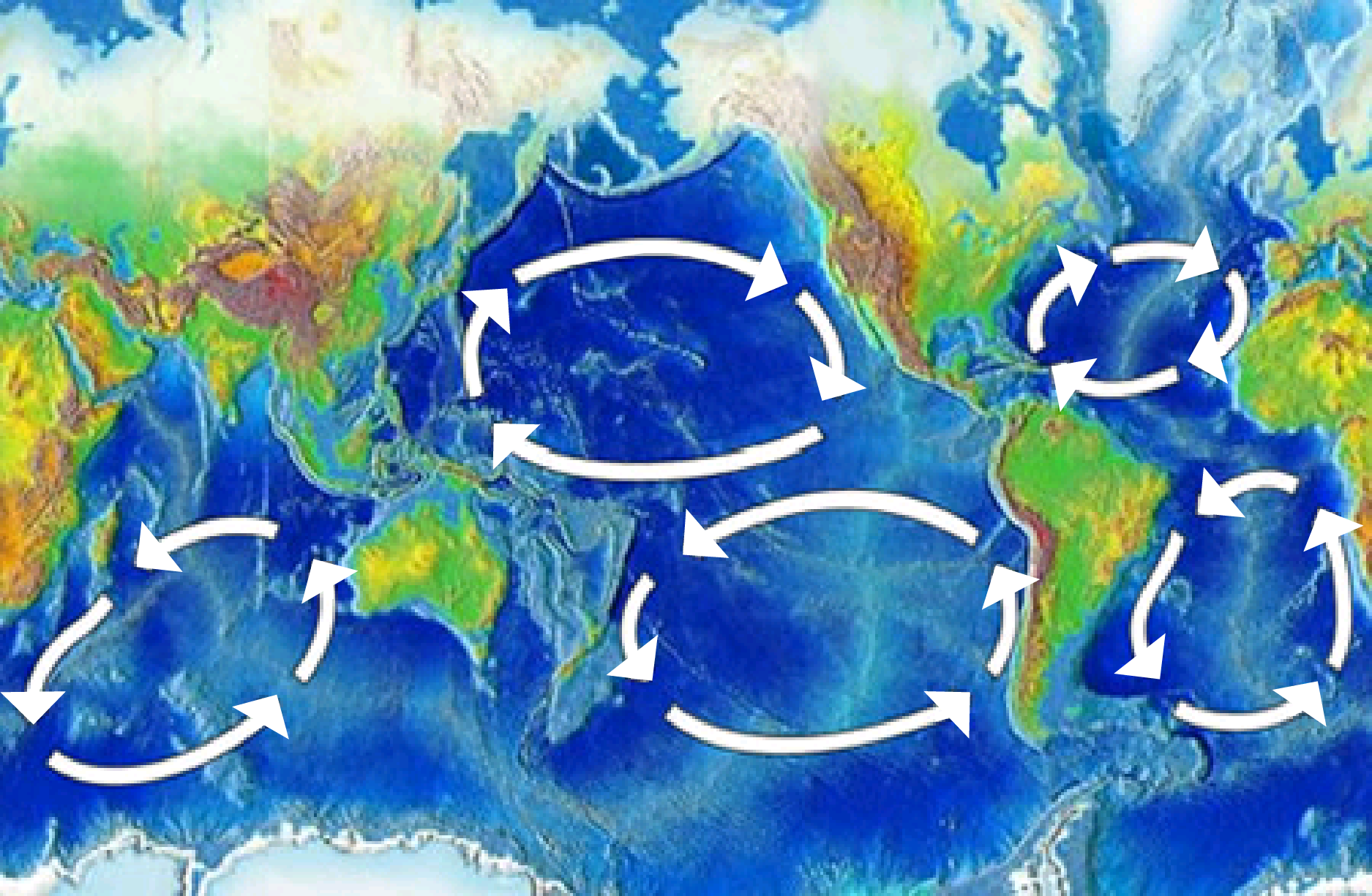
The five major ocean gyres.
The North Atlantic garbage patch is an area of man-made marine debris found floating within the North Atlantic Gyre, originally documented in 1972. The patch is estimated to be hundreds of kilometers across in size with a density of over 200,000 pieces of debris per square kilometer. The debris zone shifts by as much as 1,600 km (990 mi) north and south seasonally, and drifts even farther south during the El NiƱo-Southern Oscillation, according to the NOAA.

The NJ Legislature will now decide whether to make the changes, attempt to override Christie's veto, or let the bill die.

A new study estimates nearly 270,000 tons of plastic is floating in the world's oceans. That's enough to fill more than 38,500 garbage trucks if each truck carries 7 tons of plastic. The figure appears in a study published, Dec. 10, 2014, in the scientific journal PLOS ONE. Researchers say the plastic is broken up into more than 5 trillion pieces.

Microbeads pollution - a drop in the ocean for the beauty industry


Source: Christie vetoes N.J. ban on micro-beads feeding Atlantic Ocean garbage patch the size of France | NJ.com