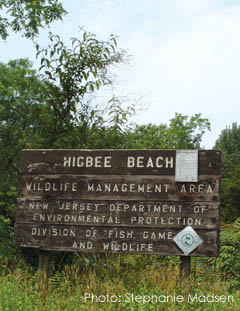
Guided walks in the Hidden Valley area of Higbee Beach WMA are being offered monthly by NJ Audubon in cooperation with the NJDEP Division of Fish and Wildlife.
The Higbee Beach Wildlife Management Area is important for its value to endangered, threatened and nongame wildlife.
This Cape May peninsula hosts one of the world's largest migrations each fall as millions of birds stop at the peninsula seeking food, cover and water. Higbee Beach plays a vital role in the migration, providing migrants with a stopover site as they increase their fitness before continuing their sojourn south.
The roughly 1,100-acre area offers a unique blend of several different habitats, including dune, forest, scrub-shrub and early successional fields. The Endangered and Nongame Species Program, in cooperation with the Bureau of Land Management, manages the fields and scrub-shrub areas for migrating songbirds and raptors.
There are two new viewing platforms that have been added to the nearly 2 miles of nature trails at the area. The platforms, which offer spectacular views of the field and forest canopy, feature educational signs on migration and habitat.
A dune trail that runs through forested dunes with views of the expansive Delaware Bay was added in 1999.
Higbee Beach is comprised of six different locales: Signal Hill, Davey’s (or Davis) Lake, Pond Creek, Sassafras Island, Hidden Valley, and the Magnesite Plant.
Hidden Valley's mix of varied habitats hosts a diversity of birds which may be encountered, including sparrows, hawks, waterbirds, and even the possibility of an owl.
According to capemay.com, Hidden Valley was once a 92-acre farm between Bayshore Road and the Pond Creek Marsh. The Dickinson family, preferring it be preserved rather than developed, sold it to the state in 1986. Part of the acreage is known as Hidden Valley Ranch and is leased for equestrian activities. The fields, trails and swamps are well known to birders.
If visiting during the fall migration, it is suggested that you go following a cold front with northerly winds. All you need is a set of binoculars and ID books.
In warmer weather, Higbee Beach is also home to lots of dragonflies and butterflies, including the long-distance migrant - the Monarch butterfly.
It has become a fall ritual for me to climb up the 500-foot basalt ledge near my home in Cedar Grove to the NJ Audubon Hawk Lookout.
From this flattened area on First Watchung Mountain, you can see birds following this first ridge west of the lower Hudson River Valley as it runs northeast to southwest. They also follow the coastline when the ridge fades away and it leads them all the way to Cape May at the tip of our state.
There will be someone from Audobon there from September 1 through November 30 from 9am - 5pm, but early October is the peak time and this month is a great month to take a look. The spring watch is from March 16 to May 15.
Hawks are on their way south for the winter. You might spot them almost anywhere in New Jersey, but you have an excellent chance of seeing some at the NJ Audubon Montclair Hawk Lookout in Essex County. This is the Audobon's smallest sanctuary at 1 acre, but it is the second oldest continuous hawk watch in the nation.
I have climbed up there each fall for a good number of years since it is in my neighborhood.
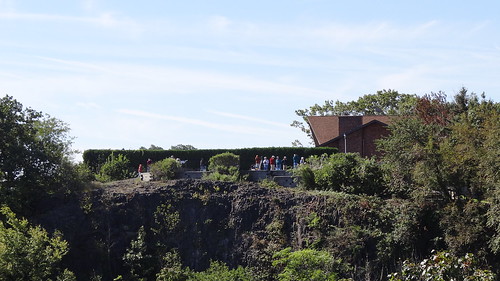
It is a stone-filled platform atop a 500-foot basalt ledge on a ridge that borders Montclair and Cedar Grove that is part of the First Watchung Mountain. Coastal and ridge flying birds follow this first ridge west of the lower Hudson River Valley. It runs northeast to southwest.
Looking north across the road is Essex County Park, Mills Reservation. A concrete pad on that cliff is all that remains of what was once a tracking location that was part of the Nike missile system. That is the location for the Spring Hawk Count as it offers better visibility to the south as hawks return to the state.
The hawkwatch is manned for fall from September 1 through November 30 from 9am - 5pm. The spring watch is from March 16 to May 15.
"October may be the most interesting time to visit the Lookout, as it offers the greatest diversity of hawk species. Chances are now better to see Merlins or even a Peregrine Falcon or two. However, by mid-month the Broad-winged Hawk flight will be over for the season, as other species begin to peak. The Red-tailed and Red-shouldered Hawk will be most numerous at the end of the month."
Dune restoration by students at Sandy Hook - Photo via ahherald.com
Marine Academy of Science and Technology (M.A.S.T.) is a co-ed four-year high school, grades 9-12. It is one of five career academies administered by the Monmouth County Vocational School District. The Marine Academy is fully accredited by the Middle States Association of Schools and Colleges. The school's curriculum focuses on marine sciences and marine technology/engineering.
The school was recognized by New Jersey Audubon and National Wildlife Federation with an Eco-Schools Award. MAST students developed and implemented a plan to increase dune vegetation lost in Hurricane Sandy. The dunes are natural line of defense in protecting coastal communities during hurricanes and other storms.
On Sandy Hook, waves and storm surges from Hurricane Sandy badly damaged the dunes and the students identified one damaged area of particular ecological importance in an area within the park called the “critical zone.” This zone is the thinnest area and susceptible to overwash and flooding from storm events.
Working under the supervision of the National Park Service, the students planted over 1,000 dune grass plants over a span of 3,000 feet along the beaches of Sandy Hook.
The National Wildlife Federation’s Eco-Schools USA program is run by New Jersey Audubon in our state with a goal to engage schools in efforts to improve student environmental literacy and skills. The MAST dune restoration project earned them the Bronze Award.
MAST students participate in the Naval Junior Reserve Officer Training Corps (NJROTC) in lieu of Physical Education. The school is is located in the Fort Hancock Historic Area at the tip of Sandy Hook, sothe project was very "local." Their campus is adjacent to the Sandy Hook Lighthouse, the oldest working lighthouse in the country.
Every fall since I have lived nearby, I have made my way up to the NJ Audubon Hawk Watch on the Montclair-Cedar Grove border in Essex County.
Though it was no doubt used for observing earlier, it came to be in September 1959 and is the organization's smallest sanctuary at one acre. But it is big in reputation, being the second oldest continuous hawk watch in the nation.
The Hawk Watch will be open between 9am and 5pm, from September through November 30th.
Climbing the stairs
From the street, a short but steep trail and stair climb will bring you atop a stone-filled platform on a 500-foot basalt ledge.
This is a ridge of the Watchung Mountains. At the border of Montclair and Cedar Grove, New Jersey, is a well constructed Montclair Hawk Lookout, a sanctuary of the New Jersey Audubon.
This is the first ridge west of the lower Hudson River Valley and runs from northeast to southwest and migrating birds use the ridgeline and the thermal to move south.
This place is a small oasis in a densely populated county. Looking south and east on a clear day, you have a view of the Verrazano Narrows Bridge, the New York City skyline including the Statue of Liberty, and northeast to the Palisades.
View to the west
To the north and west, you can see peaks from the Ramapo Mountains and the edge of the Second Watchung Mountain.
Directly north, really across the street, is the Essex County Park of Mills Reservation. A ledge there still has a concrete pad that is the remnant of the Nike tracking system that ran along the Watchung ridge in the 1960s. From the Mills reservation site, the Spring Hawk Count is conducted, as it has the best visibility to the south to see returning birds.
Chris Payne on his watch
The lookout is monitored for three months in the Fall and two months in the Spring. On my most recent visit, I met Chris Payne who is on duty for NJ Audubon this autumn.
He said that it has been a good year, particularly for Peregrine falcons who have totaled more than 70 as of early November. Most of them have already moved further south.
He tries to distinguish between migrating birds and those who stay in the area. "Locals" will circle and hunt in the area rather than ride the thermals south.
Red-tailed hawk
Red-tailed hawk riding a thermal
The numbers for broadwinged hawks are down so far. There are many buteo jamaicensis, or red-tailed hawks, which is the mascot of the nearby Montclair State University. Red-tailed hawks can be found on campus, where they perch in trees and on utility poles.
An unusual sighting for Chris this fall was a Northern goshawk, a species that, as its name suggests, does not usually go south.
You wouldn't think that raptors would be fooled by a plastic owl atop a pole, but Chris told me that the owl is sometimes attacked. Locals learn it is not real and ignore it, but migrating birds will sometimes spot it and attack. This makes for some good photo opportunities and closer looks for visitors.
The day I visited it was late in the day (3:30 pm) and getting cooler, so there wasn't much activity. It is also late in the year for some species to be still moving past this area. But it is still a nice little climb and a great view.
The platform will be closed at the end of November. As an alternative, try the ridge at Mills Reservation across the road.
Using GPS directions to 42 Old Quarry Rd, Cedar Grove, NJ will put you at the street entrance to the Hawk Watch. There is street parking and a small parking area just west of the entrance along the edge of Mills Reservation, which you can enter from that parking area and find a trail to that other lookout.
Video: A visit to the Montclair Hawk Watch - North Jersey Video 2:55 Oct 12, 2017
The NJ Department of Environmental Protection, in conjunction with the New Jersey Audubon Society, have put forward a plan to cut roughly 20 to 30 acres on Sparta Mountain annually. Opponents of the state’s plan to cut acres of trees in the Sparta Mountain Wildlife Management Area have come out strongly against the plan.
The state feels it is necessary to cut timber in order to diversify the forest and create “young forest habitat” that endangered species in the area need to thrive.
Opponents see the plan as a logging scheme disguised as a forest stewardship plan. They also feel that removal of the trees threatens an area of land that provides a large percentage of water for the state.
The anti-logging effort has been branded with the name “Stop the Chop” by the group SaveSpartaMountain.org.
A meeting in late January at the Franklin Firehouse was sponsored by the Friends of Sparta Mountain group, which included environmental speakers as well as Sen. Raymond Lesniak (D-Elizabeth).
The plan would encompass 3,400 acres of land within the townships of Sparta, Ogdensburg, and Hardyston in Sussex County and Jefferson Township in Morris County.
A recent article from the Press of Atlantic City, reminds us that protecting New Jersey's snakes, birds, frogs and other animals and plants BEFORE they are endangered is really the goal of conservationists.
In that article, the focus is on effort in the far-from-barren NJ Pinelands. The post online includes a videoand followsEmile DeVito, an expert on endangered species in the 1.1-million-acre Pinelands National Reserve, who studies the rarest plants and animals.
The Pickering's morning glory is not currently listed in NJ and so its rarity makes it the kind of species that needs attention (and will not get as much federal or state funding support) so that it is not overlooked and it moves to a threatened or endangered status.
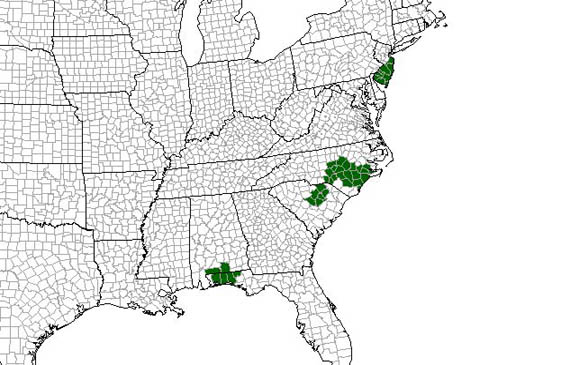
Current limited range for the Pine Barrens treefrog
The Pine Barrens treefrog is another kind of species case study. In 1979, iy was listed as an endangered species in New Jersey due to its restricted range, declining population, habitat loss, and pollution of breeding ponds. But conservation efforts moved the treefrog population to a point that it is currently considered stable.
New Jersey serves as a stronghold for this species throughout its entire range. In areas of suitable habitat, they may seem abundant. However, protection of this species is warranted, as quality habitat is limited to specialized Pine Barrens ecosystems patchily distributed throughout its range.
Flower of Stylisma pickeringii Pickering's Dawnflower or Pickering's Morning Glory, near Batsto, New Jersey.
via Wikimedia
Conservationists have long known that addressing species in decline before they reach the the stages of being threatened or endangered is the real goal.
As members of the New Jersey Conservation Foundation, New Jersey Audubon and the NJDEP track species, they can identify important habitat for that species.
For example, the docile pine snake can be tracked using implanted transmitters that allow us to discover winter dens and nesting sites.
Pine snake moving across sandy soil
We have more than 80 species of wildlife from mammals to birds to insects in New Jersey that are considered endangered or threatened. (See list at www.state.nj.us) There are also dozens of plants that are in danger that probably get less attention than the "sexier" wildlifr.
Some habitats that need protectionare less than intuitive spaces. For example, Ryan Rebozo, director of conservation science at the Pinelands Preservation Alliance, says that the edges of roads in the Pinelands could replace some lost open areas, such as those lost by dousing fires that naturally create suitable habitat. But too often road departments are mowing these areas at inopportune times when some rare plants are flowering. He estimates that 11,000 acres of road edges could be suitable habitat for some of our rare plants, such as the the Pine Barrens gentian, which needs direct sunlight and flowers later in the fall when mowing is common.
As important as education and information, such as this post, can be, it alone isn’t going to save species. People, especially volunteers and the general public, need to take action.
Have you ever heard that whistled call of "bob-white" in a grassy field or piney woods? You may have heard that distinctive song, but it's likely that you did not see a Northern Bobwhite. Their dappled plumage gives them excellent camouflage.
The birds forage in groups and scurry between cover area and will burst into flight if alarmed. Northern Bobwhite populations declined by 82% between 1966 and 2010, one of the most dramatic declines in the U.S. New Jersey Audubon and others are attempting to restore Northern Bobwhite quail to New Jersey. Bobwhites have been in sharp decline throughout the past half-century, likely owing to habitat loss and changes in agriculture, and they are an increasingly high priority for conservation.
The northern bobwhite, Virginia quail or (in its home range) bobwhite quail (Colinus virginianus) is a ground-dwelling bird native to the United States, Mexico, and the Caribbean. It is a member of the group of species known as New World quails (Odontophoridae).
The name "bobwhite" derives from its characteristic whistling call. Despite its secretive nature, the northern bobwhite is one of the most familiar quails in eastern North America because it is frequently the only quail in its range.
The Northern Bobwhite Restoration Initiative in NJ is dependent upon: (1) areas of high quality habitat and (2); the translocation of true wild birds, not pen raised, with both factors providing significant advantage in the face of severe storm events.
The release site at Pine Island has been stewarded through the implementation of a Forest Stewardship Plan, creating patches of young forest habitat suitable for quail and rich in cover and food resources. In addition, the wild birds are known to more quickly adapt and yield offspring that also exhibit innate survival instincts.
Fossil records show that quail-like birds existed at least a million years ago, but their appearance in most of the northern states across their range probably did not occur until sometime after retreat of the last glacier, approximately 10,000 years ago. Over the last 10,000 years serve storm events obviously have occurred and through it all the Bobwhite has persisted.
Project researcher Kaili Stevens tracking the Bobwhite at Pine Island.
Because New Jersey is located along the Atlantic Flyway, we are in a great place to observe hawks heading south to their wintering grounds. This is the time when migrating birds of prey come through NJ in greater concentrations as they follow our ridges and coastline.
Raptors migrate from late summer through early December, but the numbers peak between mid-September and mid-October.I have read that the best days usually occur after a day that featured a cold front with northerly winds, and mornings and early afternoons are better than later in the day.
It is pretty awesome to watch them ride the thermals, wind currents and updrafts along the Hudson River Palisades to the Kittatinny Ridge along the Delaware River and down to Cape May.
This week, I walked up the stairs to the Montclair Hawk Watch (Essex County) a observation platform that is maintained by the NJ Audubon Society. From there, you can watch migrating birds move south along the first ridge of the Watchung Mountains. On a clear day, the Verrazano Narrows Bridge, the New York City skyline and the Statue of Liberty are also in view.
The site is interesting atop a 500-foot basalt ledge on the First Watchung Mountain. There is a stone-filled platform at the top of a long staircase. They have recorded sightings of broad-winged hawks, bald eagles, American kestrels, red-tailed hawks, ospreys, merlins, sharp-shinned hawks, northern harriers, peregrine falcons and Cooper's hawks.
Directions: from the Garden State Parkway in Bloomfield, take exit 151 for Watchung Avenue and head west on Watchung to its end at Upper Mountain Avenue in Montclair, about 2.1 miles. Make a right turn and go north on Upper Mountain 0.7 miles to Bradford Avenue. Make a left turn and go up Bradford 0.1 miles to Edgecliff Road and make a right turn. Go up Edgecliff 0.2 miles and park on the shoulder (to avoid parking problems, please park well off the side of the road). The lookout path is on the south side of the road marked with a sign at the base of the steps.
Other places for watching:
Palisades Interstate Park, Bergen County, State Line Lookout - 527 feet above the Palisades.
Sunrise Mountain, Sussex County - the pavilion atop the mountain is located in Stokes State Forest in Branchville.
Chimney Rock, Somerset County in Washington Valley Park in Martinsville. This is the southern end of the Watchung Ridge that starts at the Montclair platform.
Raccoon Ridge in Blairstown is on the Kittatinny Mountains at an elevation of 1,563 feet and Scotts Mountain, also in Warren County at the Merrill Creek Reservoir in Washington.
Down at the tip of the state at Cape May Point State Park birds riding air currents from the surrounding Atlantic Ocean and the Delaware Bay head south overhead.
Baird's Sandpiper (Calidris bairdii) by Dominic Sherony [CC BY-SA 2.0 via Wikimedia Commons
Via the "Seen in New Jersey" column written by Pete Bacinski (New Jersey birder and retired NJ Audubon All Things Birds program director) comes the reminder that shorebirds are now returning from nesting grounds in the high Arctic to the Jersey shore.
Like many NJ people, these birds have found that the late summer and after Labor Day are very nice times to enjoy our state. People think of migrations as an autumn event, but in this case this part of August is the time for neotropic migrant passerines, or perching birds, to migrate and it is the peak of shorebird migration. Pete says that the second half of August has the highest shorebird diversity of the year.
This is a great time to see birds foraging in mudflats, sandy beaches, sod farms and grassy areas. A choice spot is the Forsythe National Wildlife Refuge. This refuge has 47,000 acres of marshland and forest and the Brigantine Division in Galloway is the place to be for shorebirds at this time of year.
Other locations worth checking:
Barnegat Impoundments, in Barnegat Township, also part of Forsythe NWR
TNC Meadows in Cape May
Stone Harbor
Island Beach State Park
Sandy Hook (north end)
New Jersey Meadowlands, around the DeKorte Environment Center
Whitesbog cranberry bogs and mudflats (when drained)
Baird's sandpiper (shown at top) and the buff-breasted sandpiper, as well as the rare American golden plover love sod farms and grassy fields in places like Brigantine.These two sandpipers (AKA grasspipers) don't appear here in spring migration because they take a central flyway when they head north. Upland sandpipers, a New Jersey endangered species, is ending its migration through NJ now.
New Jersey Audubon's All Things Birds will sponsor these birding field trips:
Aug. 23: Forsythe (Brigantine) National Wildlife Refuge
Aug. 30: Forsythe (Brigantine) National Wildlife Refuge
There is a fee for these events: $20 for members and $25 for nonmembers. For more information or to register, call the Scherman-Hoffman Wildlife Sanctuaries at (908) 766-5787.
Ecologist Raymond Semlitsch and his doctoral student Katie O’Donnell are researching part of the Mark Twain National Forest in Missouri for salamanders. They crawl along the ground, raking the leaf litter with their hands, looking under rocks and logs, and when they find salamanders, they lift them gently from the dirt to be weighed and measured.
They are building a model of salamander populations and using the data from the sites they studied, they can estimate salamander populations in other parts of the woods.
How many salamanders are in the woods? The answer, according to the model, is between 1.88 and 2.65 billion salamanders. That’s within a district of the Mark Twain National Forest about 2,800 square kilometers in area, and those numbers 2-4 times higher than estimates made by other scientists in the 1970s.
Those earlier researchers, studying salamanders in the woods of New Hampshire, didn’t account for amphibians hiding underground. And more recent studies of other salamander species have found up to 10 times more salamanders than the 1970s research.
What about here in New Jersey?
NJDEP, Division of Fish and Wildlife’s Endangered and Nongame Species Program and the Conserve Wildlife Foundation of NJ have enhanced a complex of 12 vernal pools in Cape May County to create habitat for state-endangered eastern tiger salamanders and other vernal pool breeding amphibians. The interconnecting pools allowed eastern tiger salamanders to return to vernal pools to breed in early winter.
In mid-December, eastern tiger salamander egg masses can be found in the pools and egg masses collected from other sites have also been introduced into these pools as supplements.
Every year, volunteers on a wooded road in northwestern New Jersey spend some early spring nights looking for frogs and salamanders to count.
They wait for the amphibians to cross the road on their way from the wooded uplands where they winter to the marshy lowlands and vernal pools where they will do their spring mating
Wood frogs and blue-spotted salamanders are more common amphibians in northern New Jersey and not endangered.
The NJ’s Endangered and Nongame Species Program and Conserve Wildlife, along withe the NJ Audubon Society are partners on the Amphibian Crossing Survey Project. Relying again on volunteers to help monitor sites in Warren and Morris County, they identify additional crossings throughout the northern region of the state. (Due to limited resources, they are currently focusing efforts on northern New Jersey.)
It is estimated that one third of the world’s amphibians are threatened with extinction, according to the International Union for the Conservation of Nature (IUCN).
Red Knot - Bob William philly.com/philly/news/new_jersey
The Red Knot, a shorebird which has undergone a drastic decline in recent years, will be listed by the U.S. Fish and Wildlife Service as a threatened species under the Endangered Species Act, according to the New Jersey Audubon.
The action, which is expected to be announced next week, is a critical step toward the long-term protection and recovery of the species, said New Jersey Audubon, which has long addressed issues related to the Red Knot and other shorebirds.
The listing would mean that the species meets the Endangered Species Act criteria of being likely to become in danger of extinction in the foreseeable future throughout all or a significant portion of its range.
"The Red Knot utilizes the shores of the Delaware Bay extensively during its amazing bi-annual migration between its Arctic breeding grounds and South America," said New Jersey Audubon's President and CEO Eric Stiles.
Warming weather not only brings some bird species to NJ, but brings out the more reluctant birders. Even if you're not a "birder" officially, you probably are paying more attention to seeing birds in your neighborhood.
NJ Audubon offers lots of information for anyone on either end of the birding continuum.
NJ Audubon's Nature Center of Cape May The Cousteau Center at Bridgeton is seeking volunteers on August 16, 2010 to assist with the Project PORTS (Promoting Oyster Restoration through Schools) project.
Project PORTS is a community-based restoration project that engages school children in activities associated with the enhancement of oyster habitat at the Gandy's Beach Oyster Restoration Enhancement Area.
shells with spat
Students construct shell bags, which are deployed in the bay to become a settlement surface, and home to millions of young oysters. Participating schools, PORTS Partner Schools, receive a truckload of clam shells, which are placed in stretchy mesh bags by students on site at the school. The bags are then transported to a lower Bay Cape Shore site where they are deployed for two months in the summer to capture the settling oysters known as spat.
The oyster spat and shell are transplanted to the upper Bay Gandy's Beach location will they will remain to grow, thrive, and provide important ecological benefits to the Bay ecosystem.
This work complements the State and Federal fishery-centered restoration efforts and demonstrates a way that local citizens can invest in the Delaware Bay and feel a personal commitment for its stewardship.
This year students at partner schools constructed 2700 shell bags. The shell bags were placed in the lower Bay in late June and have since been collecting thousands, if not millions of oyster spat.
These young oysters will be transplanted to upper bay conservation and fishery areas on August 16.
PORTS needs at least 30 volunteers on August 15 and 16 to help prepare and load the bags onto skiffs for transport.
Mature oyster
The eastern oyster, Crassostrea virginica is one of, if not the most important species of the Delaware Estuary.
Dating back thousands of years, the oyster has served as a keystone organism in the estuary, positively influencing water quality and providing food, habitat, and refuge to countless organisms. Challenged by disease, habitat deterioration, and overfishing, the resource is presently a fraction of what it once was.
NJ Audubon's Nature Center of Cape May Join Naturalist and Butterfly Expert Patricia Sutton for her 19th season of spectacular private butterfly garden tours beginning next weekend.
The tours will take place Friday through Sunday, July 16, 17 and 18 and include the best butterfly gardens throughout Cape May County.
Friday’s tour on July 16 will feature gardens in and near Cape May Point and Cape May City.
Saturday’s tour on July 17 focuses on gardens from North Cape May to Rio Grande, and the final tour on Sunday, July 18 will visit gardens from Goshen to Dennisville and Eldora, including guide Pat Sutton’s own garden in Goshen.
Call the nature center now at 609-898-8848 to reserve your spot and get further details.
NJ Audubon and the NJ DEP's Division of Fish and Wildlife are hosting a free seminar on Northern Bobwhite Quail Management in New Jersey on April 29th, 2010 from 7:00 p.m. until 8:30 p.m. in Woodstown, NJ.
Featured speaker Dr. Chris Williams of the University of Delaware, will discuss the characteristics of good bobwhite quail habitat.
Paul Castelli, Research Scientist for NJ Division of Fish & Wildlife, will discuss the declining population trend, causes for decline, necessary management and the state's new Bobwhite Quail Action Plan.
Presentations will be followed by a panel discussion with speakers and local bobwhite quail experts.
The seminar location is the Ware Agricultural Extension Office, 51 Cheney Rd., Woodstown, NJ 08098. RSVP is encouraged. Contact 609-861-1608 ext. 24 to RSVP or for more information.
There are widespread declines in amphibian populations globally. Studying local populations can help us more effectively protect their habitats.
Amphibians often play important and keystone roles in the natural world as indicators of functioning healthy ecosystems and as part of the predator - prey relationship. Like birds, they often signify a "canary in the coal mine" because widespread declines may indicate far reaching problems in the ecosystem. Herpetologists around the world have initiated research and conservation efforts to identify problems associated with these declines and come up with solutions to counteract them. The incredibly high extinction rate of some species can be attributed to:
Why did that frog, toad, or salamander cross the road? Amphibian populations require habitat with abundant food supplies, breeding areas, and hibernation sites - and they need a safe travel path between these sites.
The always increasing development here in NJ and the entire northeast continues continues to separate hibernation sites from breeding pools with road crossings that amphibians must travel.
There are some amphibians (vernal pond obligates VPOs) that can only reproduce successfully in vernal ponds. Why vernal (spring) pools? These pools only hold water for several months in the spring, so they are not places for amphibians to "live" but their short existence also ensures that fish can not live there and so will not eat the amphibian's eggs or young.
Most of these species are moving from safer upland forests on the first warm rainy nights to these vernal ponds. There, it is amphibian dating time. They search for mates, breed and lay their eggs for the next generation.
Spring Amphibian Migration 2010 video shows volunteer training and two crossings.
These amphibians might be living in your backyard or a small woodlot near you. You probably wouldn't even notice any "road kill" as nocturnal scavengers do a good job of cleaning up the evidence by morning.
Volunteers learn how to identify amphibian crossing sites (generally historic migratory routes from past years) and conduct night surveys on suitable weather nights to look for frogs and salamanders crossing roads.
They collect amphibian mortality data for the NJ Endangered Species Program. They also act as "crossing guards" to help amphibians negotiate dangerous road crossings during the most stressful time of their life cycle.
Of course, all volunteers also act as ambassadors for the project by educating other people about what they do.
Obligate Vernal Pool Breeding Amphibians:
Eastern tiger salamander (Ambystoma t. tigrinum) Endangered
Marbled salamander (A. opacum) Special Concern
Spotted salamander (A. maculatum)
Jefferson salamander (A. jeffersonianum) Special Concern
Blue-spotted salamander (A. laterale) Endangered
Wood frog (Rana sylvatica)
Eastern spadefoot toad (Scaphiopus holbrookii)
Facultative Vernal Pool Breeding Amphibians:
Green frog (Rana clamitans melanota)
Bullfrog (R. catesbiana)
Pickerel frog (R. palustris)
Southern leopard frog (R. utricularia)
Carpenter frog (R.virgatipes) Special Concern
Northern cricket frog (Acris crepitans)
Northern spring peeper (Psuedacris crucifer)
New Jersey chorus frog (P. triseriata kalmii)
Upland chorus frog (P. triseriata ferarium)
Northern gray treefrog (Hyla versicolor)
Southern gray treefrog (H. chrysocelis) Endangered
Pine Barrens treefrog (H. andersonii) Threatened
Four-toed salamander (Hemidactylium scutatum)
Long-tailed salamander (Eurycea l. longicauda) Threatened
American toad (Bufo americanus)
Fowler's Toad (B. fowlerii) Special Concern
In addition to amphibians, there are several reptiles that inhabit vernal pools on a seasonal basis, primarily to eat the eggs and larvae of amphibians:
Wood turtle (Glyptemys insculpta) Threatened
Spotted turtle (Clemmys guttata) Special Concern
Mud turtle (Kinosternon subrubrum)
Eastern painted turtle (Chrysemys picta picta)
Common snapping turtle (Chelydra serpentina serpentina)
The Essex County Environmental Center is a facility of the Essex County Park System. It is located in West Essex Park which stretches along six miles of the Passaic River starting at Bloomfield Avenue in Fairfield and ending just beyond South Orange Avenue in Livingston.
The immediate grounds of the Essex County Environmental Center include approximately one mile of trails in a wooded wetland habitat with access to the Upper Passaic River.
Also on site are the newly renovated Garibaldi Hall, fishing and boating areas, a greenhouse and gardens, a raised boardwalk, and picnic areas.
The former Park Commission first began acquiring land for West Essex Park in 1955. Money to purchase the first piece of property came in part from the sale of Oraton Parkway to the New Jersey Highway Authority.
Over subsequent years, other land was purchased from more than 70 individual landowners. The Center for Environmental Studies was established in 1972 and functioned for over 23 years as a place to educate students about the environment. It was officially closed in 1995 due to lack of funding but organizations such as Rutgers Cooperative Extension, the 4-H, and Master Gardeners continued providing services and programs at the site on a limited basis to meet the needs of the community.
Essex County Environmental Center was dedicated and opened in May 2005. This state-of-the-art facility was constructed as an environmentally sensitive building using natural and recycled materials, innovative energy saving technologies, and topped by a "green roof" for the purpose of storm-water management. It also houses a large public meeting room, interactive exhibits, a wet lab, and a library.
New Jersey Audubon and the County of Essex have entered into an educational programming partnership at the Essex County Environmental Center. NJAS provides Outreach Programs for all ages and groups, Birding Field Trips in Essex County,Saturday Family Programs and Summer Nature Day Camp.
Center hours: Monday to Friday, 9:00 a.m. to 5:00 p.m. / Saturday, 10:00 a.m. to 2:00 p.m. / Closed Sundays Trails: Open dawn to dusk seven days a week. Check website for holiday closings.
You are cordially invited to attend the 18th Annual Watchable Wildlife Conference at the Golden Inn in Avalon, New Jersey, October 6-8, 2009. The conference is sponsored by Watchable Wildlife, Inc., New Jersey DEP's Division of Fish & Wildlife, New Jersey Division of Travel & Tourism, New Jersey Audubon Society, Conserve Wildlife Foundation, and the Association of New Jersey Environmental Commissions.
The Watchable Wildlife Conference is the premier meeting of wildlife and tourism professionals in North America. Holding the conference in New Jersey this year provides a great opportunity to participate in detailed sessions , which demonstrate how local communities and businesses can capitalize on the wildlife tourism trend. This conference is a rare chance to meet and talk with national and New Jersey's leading wildlife managers, business owners, authors and tourism marketing professionals in the field of wildlife/nature tourism.
This year's focus will be Nature Tourism as an Economic Stimulus: Keeping it Local.
Speakers at this year's conference include Peter Dunne, Author and Director of the Cape May Bird Observatory, Michael G. Ensch, Chief of Operations & Regulatory for the US Army Corps of Engineers, and Steve Atzert, US Fish and Wildlife Service Refuge Manager, Edwin B. Forsythe NWR.
Recent reports show people are traveling to their National Parks, State Parks and local natural areas more than ever. Now is the time to learn how to benefit from your community's natural capital.
The Golden Inn Hotel & Conference Center will be the host site. Reduced conference rates including government per diems have been arranged. For more information visit the Golden Inn site at http://www.goldeninn.com. Conference registration is $350 and includes most meals. A special one-day rate of $125 for professionals and $90 for students is available.
Lorrimer Sanctuary was bequeathed to the New Jersey Audubon Society by Ms. Lucine L. Lorrimer in 1956. It is one of 10 staffed centers in NJ.
The main house, parts of which date back to the late 1700's, is the present visitors' center and Sanctuary office. It has an exhibit and lecture room, winter bird feeding station, interpretive displays, hands-on exhibits, and a gift shop, the proceeds of which benefit the Sanctuary.
There is a self-guiding trail system that winds through the 14 acres of land.
Much of the acreage is second-growth woods (mostly oak, maple, ash, and beech); and small stands of planted evergreens. The trails are open during Sanctuary hours.
Grey tree frog Originally uploaded by Jersey Bug From the NJ Audubon Flickr groupFor children(Pre-K through Grade 6), the Sanctuary offers programs including one on endangered species. Offerings include: Summer Natural History Day Camps, Class Field Trips, "On-Site" School Programs, Boy Scout and Girl Scout Classes and Saturday Nature Classes.
For adults, there are Nature Study Workshops, Slide Presentations for Groups, Nature Weekends, Teacher Education Workshops and Birdwatching Field Trips.
PROGRAM REGISTRATION – PREREGISTRATION IS REQUIRED FOR ALL PROGRAMS, since group size is limited and a minimum number of participants is necessary. Paid registration, including a daytime phone number, at least one week prior to the program ensures a place.
790 Ewing Avenue PO Box 125 Franklin Lakes, NJ 07417 (201) 891-2185
HOURS: Wednesday to Friday 9:00 a.m. to 5:00 p.m. Saturday 10:00 a.m. to 5:00 p.m. / Sunday 1:00 to 5:00 p.m







_(3972162983)_(2).jpg)


 habitat.


