Showing posts with label Ocean County. Show all posts

Sunday, April 27, 2025

Pine Barrens Wildfire

A teenager was arrested for arson last week, accused of starting the the Jones Road Wildfire in southern New Jersey's Lacey and Ocean townships. The fire is on track to be the state’s largest in almost 20 years, burning at least 15,000 acres in three days.

The fire threatened the delicate Pinelands ecosystem, displacing wildlife, and forcing thousands of residents to evacuate. Igniting on April 22, 2025, in the Greenwood Forest Wildlife Management Area near Barnegat Township. It triggered a state of emergency, closed major highways including the Garden State Parkway, and left more than 25,000 homes without power. 

The wildfire broke out near 19-year-old Joseph Kling’s home. Prosecutors say he lit a bonfire in the Pine Barrens and abandoned the site after only partially extinguishing it. 

The Greenwood Forest Wildlife Management Area, a cornerstone of the Pinelands, is home to endangered species like the Pine Barrens tree frog and threatened species such as the northern pine snake. While the Pinelands' pitch pines and scrub oaks can adapt to periodic fires, the intensity of the wildfire could disrupt habitats and force wildlife into residential areas. Similar fires in Passaic County last fall saw animals seeking refuge in backyards, prompting experts to urge residents to provide water and space for displaced creatures.

New Jersey's 21 counties remain at heightened risk, with the New Jersey Forest Fire Service working tirelessly to contain the blaze. Helicopters and ground crews are deployed, but the fire's size and unpredictable winds pose significant challenges.

It's peak fire season for the area, with low humidity, winds, abd warming temperatures. New Jersey’s wildfire season, along with long-term drought, contributed to the spread. Firefighters have contained much of the Jones Road fire through controlled burns—removing dry vegetation that might otherwise fuel it. 

SOURCES

natureworldnews.com/articles/72571/20250423/massive-new-jersey-wildfire-devastates-8500-acres-threatens-wildlife-communities-amid-historic.htm

Photos: https://www.nydailynews.com/2025/04/24/new-jersey-wildfire-jones-road-fire-photos/ 

newjersey.news12.com/new-jersey-forest-fire-service-jones-road-wildfire-is-60-contained-15300-acres-burned

nbcnews.com/weather/wildfires/new-jersey-wildfire-continues-burn-thousands-evacuated-rcna202541

Saturday, July 21, 2018

Advisory on Clinging Jellyfish in Barnegat Bay


Clinging jellyfish, a nonnative species with a powerful sting, have been confirmed in the north-central region of Barnegat Bay, prompting the Department of Environmental Protection to expand a recreational-use advisory to the entire bay.

The advisory follows advisories the DEP previously issued for recreational users of northern Barnegat Bay, the Metedeconk River in Ocean County and the Shrewsbury and Manasquan rivers in Monmouth County.

About 40 clinging jellyfish were confirmed in north-central Barnegat Bay on Monday – at Jonny Allens Cove on the bayside of Island Beach State Park and in eelgrass beds on the north side of Tices Shoal, a popular boating and watercraft area on the bay side of the park.

The jellyfish collected in both areas were in varying stages of maturation.

The clinging jellyfish is not known to inhabit ocean beaches or other sandy areas but tends to attach itself to submerged sea grass and algae in back bays and estuaries, areas not heavily used for swimming.

Recreational users of the bay, including those using the popular Tices Shoal area, are advised to be vigilant to the possible presence of clinging jellyfish. Clinging jellyfish stings can produce severe pain, muscle cramping and other localized symptoms. In some individuals, stings can result in hospitalization.

In Barnegat Bay, beds of sea grass can provide ideal habitat for clinging jellyfish, which are very small and hard to see in the water. The clinging jellyfish ranges from the size of a dime to about the size of a quarter. It has a distinctive red, orange or violet cross across its middle.

The DEP encourages the public to use common sense and caution in areas where jellyfish are suspected. Anyone wading through these areas, especially near sea grass, should wear boots or waders to protect themselves.

The clinging jellyfish was first confirmed in New Jersey in 2016 in the Manasquan River at the Point Pleasant Canal. The DEP is working in partnership with Montclair State University to continue clinging jellyfish surveys in the bay.

If stung by a clinging jellyfish:

  1. Apply white vinegar to the affected area to immobilize any remaining stinging cells.
  2. Rinse the area with salt water and remove any remaining tentacle materials using gloves or a thick towel.
  3. A hot compress or cold pack can then be applied to alleviate pain.
  4. If symptoms persist or pain increases instead of subsiding, seek prompt medical attention.

People are advised against trying to capture clinging jellyfish. Take a photograph if possible and send it to Dr. Paul Bologna at bolognap@mail.montclair.edu or Joseph Bilinski at joseph.bilinski@dep.nj.gov along with location information.

For a fact sheet on clinging jellyfish, visit www.nj.gov/dep/docs/clinging-jellyfish-factsheet.pdf

For a PowerPoint presentation on DEP clinging jellyfish research, visit www.nj.gov/dep/docs/clinging-jellyfish-distribution.pdf

SOURCE https://www.nj.gov/dep/newsrel/2018/18_0059.htm

Monday, April 23, 2018

Sedge Island Summer Field Experience

banner-kayak

Did you know that the bay area around the Sedge Islands is the state's only Marine Conservation Zone? 

Sedge Island is a very unique and pristine salt marsh ecosystem that is home to a variety of wildlife, including the state's most densely populated colony of nesting ospreys (a state-threatened species).

Sedge Island is located just off of Island Beach State Park in the Barnegat Bay.

Summer programs for adults and children at Sedge Island are offered by the Conserve Wildlife Foundation of NJ, our partner in many management, research and educational programs. Programs range from fishing to kayaking to professional development workshops for teachers.  To learn more, visit the CWF's Sedge Island Summer Field Experiences page.

Friday, October 6, 2017

Annual Fall Forestry Festival October 7 in Ocean County


Outdoor enthusiasts, crafting devotees, and fans of all things arboreal will gather again on Saturday October 7 at the Department of Environmental Protection’s Forest Resource Education Center in Jackson Township, Ocean County for the 23rd Annual Fall Forestry Festival. The festival will be held from 10 a.m. to 3 p.m., rain or shine. Admission and parking are free.

“We invite all New Jerseyans to visit our Fall Forestry Festival to learn about trees and enjoy the outdoors,” said DEP Assistant Commissioner for Natural and Historic Resources Richard Boornazian. “The festival’s nature-themed activities and programs are sure to entertain and delight children and parents alike.”

“This festival is also a great time for birders, scouts, hikers, and anyone who appreciates forests and woods,” added State Forester John Sacco. “This event is here for people to gain a better understanding of New Jersey’s vast forest resource.”

Visitors will get the chance to meet beloved outdoor mascots Smokey Bear and Woodsy Owl, take a hayride, visit the New Jersey Tree Nursery, or join one of the many guided hikes scheduled throughout the day. Professionals in the natural resource field will also be on hand to give tips on water and soil conservation, composting, invasive insects and diseases, maple sugaring, managing your backyard forest, and more.

Children, teens, and parents alike can plant acorns, build a wooden craft, make music in “Sounds of the Forest,” and even put on a harness and climb the old white oak tree. Plans are in place for demonstrations of the center’s sawmill and the utilization of logs from storm and/or insect damaged trees from around the state to be milled into useable lumber.

On the forest safety side, fire wardens will be on hand showcasing firefighting tools and equipment, as well as demonstrating how homeowners in our wooded areas and forests can help make their property “firewise.”

“Living in our forested areas means living with the potential for wildfires impacting their homes and property,” said State Fire Warden Steve Holmes. “We will be providing information on firewise gardens, which is the practice of making smarter landscaping choices to best protect our homes from wildfires.”

In 1994, the Department of Environmental Protection’s Forest Resource Education Center in Jackson hosted the first Fall Forestry Festival, drawing attention to the work the center does in educating the public about forest stewardship — managing New Jersey's forest resources so that we have healthy trees and forests, clean air and water, and places to learn about and enjoy the outdoors. Food and beverage will be available for purchase at the Festival. Sturdy hiking shoes and insect repellant are encouraged.

Parking is available for the festival at 370 E. Veterans Highway, Jackson. For driving directions to the Forestry Festival, call the Forest Resource Education Center (FREC) at 732-928-2360 or visit www.forestrycenter.nj.gov .

The Forest Resource Education Center (FREC), operated by the DEP's NJ Forest Service, is committed to providing exceptional conservation education programs that promote benefits of trees and forest stewardship to all age groups at no cost. It is the sole public facility in NJ focused on forestry education. Located on 875 acres, the FREC also offers miles of trails for hiking, biking, and nature watching.

The Toms River, which runs through the FREC, is regularly stocked with trout to provide an exciting fishing experience for anglers. For more information, please visit the FREC’s website at: www.state.nj.us/dep/parksandforests/forest/njfs_frep.html. Many programs may fulfill requirements for scouting badges. To be added to the scout mailing list, email FREC@dep.nj.gov

The New Jersey Forest Tree Nursery, co-located on the same property, grows 300,000 seedlings yearly for reforestation efforts across the state. The Nursery has grown and distributed more than 220,000 tree seedlings for the Tree Recovery Program, providing them to New Jersey residents to replace trees lost in Superstorm Sandy. It also provides trees and seedlings for Arbor Day events and also boasts seedlings that flew in space on the Shuttle Columbia in 1997.

To learn more about the New Jersey Forest Tree Nursery, please visit their website at: www.state.nj.us/dep/parksandforests/forest/nj_forest_nursery.htm


Wednesday, July 27, 2016

There's a Rattlesnake in the Neighborhood

A timber rattlesnake found in Manchester, NJ
(Credit: Manchester Police)
There is something about seeing certain species that automatically put the average citizen into panic mode. This is true with sharks, bats, some insects and snakes. For all of those examples, there are different species within our state of shoreline and some are potentially dangerous while others are not at all.

The danger for these species is that many people react in the same way to all of them - kill them.

The summer always brings media reports of sharks offshore and sometimes of snakes.

New Jersey has a good number of snake species (22), but only two are venomous - the timber rattlesnake and the copperhead. I have written often here about snakes, particularly because four are endangered or threatened.

One of the endangered snakes is the timber rattlesnake and this month a sighting in a New Jersey neighborhood made its way onto the NY TV news.

A CBS News report said that rattlesnakes have been spotted "slithering" around Manchester Township, in Ocean County.

The timber rattlesnake inhabits three areas of NJ – the Kittatinny Ridge and the northernmost portion of the Highlands as well as the sprawling Pine Barrens of southern New Jersey.

The copperhead is limited to hilly, forested regions in portions of northern New Jersey and a few isolated, hilly areas of Hunterdon and Somerset counties.

Everyone knows that the rattlesnake has its rattle to distinguish it from other snakes, but many other snakes mimic the rattlesnake by shaking their tails on leaves, twigs and other objects.

A rattlesnake has jagged and dark bands extending from side to side around the center and back end of the snake.

They are a rare sighting, but, yes, being bitten by one can cause death. Police in Manchester posted photos on Facebook, warning residents of confirmed sightings of a venomous snake of about five feet in length near Pershing Avenue in the Whiting section of the township.

Timber rattlesnakes like to bask in the sun when they come out of their dens in May, but are passive unless they are threatened or provoked - whether that is intentional or accidental. Now is the mating season, and male timber rattlesnakes are out seeking out females.

Of course, you should not approach or try to handle them or remain in the area. You should not try to kill them. In New Jersey, they are on the endangered species list and intentionally killing one is illegal.

If you see a timber rattlesnake, you should note the time and place and call the New Jersey Endangered and Non-Game Species Program at (609) 628-2103 for southern New Jersey, (908) 735-8975 or (908) 735-9281 for northern New Jersey, or (877) WARN-DEP on weeknights or weekends.


Friday, April 24, 2015

Run, Walk or Bike at the Jersey Shore

Jersey Shore in Motion has a nice list of running and walking trails in Monmouth and Ocean County.

Cattus Island County Park - 1170 Cattus Island Blvd, Toms River, has a trail system that is great for an easy hike. Designed to provide access to the most beautiful areas of the property, you can seek out the returning migratory songbirds or witness the osprey building her nest along the 1,500-foot boardwalk or on one of the other trails in this 500-acre Ocean County sanctuary.

Double Trouble State Park - 581 Pinewald Keswick Road, Bayville, is an active cranberry farm, and it also features a marked 1.5-mile loop and several miles of unmarked paths. Located on the eastern edge of the New Jersey Pine Barrens, the Nature Trail identifies 20 points of interest from endangered plants to native animals.

18 more possibilities at jerseyshoreinmotion.com

Friday, June 27, 2014

Testing the Waters at the Jersey Shore


Testing the Waters is a guide to water quality at vacation beaches. The state summary for New Jersey ranked our state third in beach water quality (out of 30 states. Only 3% of samples exceeded the national Beach Action Value for designated beach areas in 2013.

New Jersey has public beaches lining 127 miles of the Atlantic coast. The Cooperative Coastal Monitoring Program (CCMP), which is administered by the New Jersey Department of Environmental Protection, conducts quality monitoring from mid-May to mid-September.

You can find daily activity reports, including beach closings and advisories, at www.njbeaches.org (the CCMP website). As I write this, the Jersey shore beaches are all green lights and open.

In 2013, New Jersey reported 492 coastal beaches and beach segments, 288 of which were monitored. New Jersey also has "bracket" beaches that are adjacent to regularly monitored beaches; if high bacteria concentrations are found at a regularly monitored station, sampling is conducted at bracket stations to determine the extent of the affected area.

That 3% number means that of all reported beach monitoring samples, 3% exceeded the Beach Action Value (BAV) of 60 enterococcus bacteria colony forming units (cfu) per 100 ml marine or estuarine water in a single sample.

The 4 beaches in NJ that did exceed the rate with the highest percentages in 2013 were Berkeley Township at Beachwood Beach West in Ocean County (52%), Neptune Township at Shark River Beach and Yacht in Monmouth County (20%), Berkeley Township at West Beach Avon Road in Ocean County (18%), and Brick Township at Windward Beach in Ocean County (17%).

Wednesday, September 11, 2013

4th Annual New Jersey Wild Outdoor Expo This Weekend


The 4th annual New Jersey Wild Outdoor Expo will be held on Saturday and Sunday, September 14 and 15, 2013, from 10:00 a.m. to 5:00 p.m. daily at the Colliers Mills Wildlife Management Area in Jackson Township, Ocean County.

The Expo hosts, DEP’s Divisions of Fish and Wildlife and Parks and Forestry, the Green Acres Program, and the Conserve Wildlife Foundation of New Jersey, are looking for additional volunteers excited by the thought of helping people connect to the natural world to help at this event.

This free event provides visitors with a unique blend of conservation information, education and hands-on opportunities to learn outdoor skills and activities that can be enjoyed in New Jersey’s great outdoors! Visitors can learn about and try a wide array of activities including fishing, shooting sports, kayaking, rock climbing, biking, camping skills, wildlife watching and much more.

Saturday, September 29, 2012

Island Beach State Park's Second Season


Island Beach State Park is one of New Jersey’s most popular parks, a picturesque strand of coastline visited by a million people each year. A vast majority visit in the summer, drawn to beaches that offer a more natural experience than can be experienced anywhere in New Jersey.

But the season doesn't end with Labor Day. During the Jersey Shore's "second season" at Island Beach offers surf fishing for stripers at sunrise, intimate kayak explorations of Sedge Island on Barnegat Bay, crabbing and clamming along quiet coves, tiny shorebirds searching for morsels along the surf line, the wonders of a child learning about barrier island ecosystems from a park naturalist – can be enjoyed all summer long, or long after the crowds have gone.

Stretching for nearly ten miles of Ocean County, the 3,000-acre park protects the last significant stretch of undeveloped barrier island ecosystem in the state, the sandy necklace of New Jersey’s park system. The island’s dunes remain virtually untouched since the first written accounts of New Jersey’s coast were penned during the voyage of Henry Hudson’s “Half Moon” in 1609.

The park officially opened in 1959, largely from land purchased from Henry C. Phipps, a partner of industrialist Andrew Carnegie. The state wanted to preserve an area of the rapidly developing shore for swimming, hiking and fishing.

Now a peninsula, the area that was Island Beach was once cut off by an inlet, believed to have been located in the area of present-day Ortley Beach. The inlet was closed off by the natural drifting of sand in the early 1800s.

Fishing has been popular on Island Beach, long before it was a park. Stripers, fluke, bluefish, kingfish, and blackfish are just some of the species that can be hooked, depending on the season. Access for people with disabilities is available.

The Nature Center contains multiple exhibits on the Barnegat Bay watershed, shells and various animals found around the park. One of the several self-guided trails on the island, the Johnny Allen’s Cove Trail, starts near the center and provides and introduction the park’s varied ecosystems. The Spizzle Creek Bird Blind Trail gives visitors the chance to see ospreys or wading birds from a bird blind.

History lovers can take the Time-Travel Trail hike, which offers glimpses of the past on a walk to the site of the Reed’s Hotel, fancied by 19th century sportsmen hunting waterfowl on Barnegat Bay. On Island Eco-Hikes you may see countless fiddler crabs burrowing into marsh mud or perhaps catch a glimpse of diamondback terrapins (New Jersey’s only saltmarsh turtle), a fox, or even seals basking on marshy hummocks.

SOURCE: http://www.nj.gov/dep/daw/islandbeach/

Wednesday, September 12, 2012

NJ WILD Outdoor Expo This Weekend


The New Jersey WILD Outdoor Expo celebrates the state's bountiful natural resources and rich outdoor heritage. The event will held on September 15 and 16 in 2012, from 10 a.m. to 5 p.m. daily at the Colliers Mills Wildlife Management Area in Jackson Township, Ocean County. The Expo is an annual event which is free of charge and takes place rain or shine.

The WILD Outdoor Expo is hosted by the NJDEP Division of Fish and Wildlife, Division of Parks and Forestry, the Green Acres Program and the Conserve Wildlife Foundation of New Jersey. The event also has several sponsors, and exhibitors and vendors from the field of outdoor recreation will be on site. Food vendors will also participate; you are welcome to bring and enjoy your own in the picnic tent.

The Expo helps people connect with the natural world by providing a unique blend of conservation information, education and hands-on opportunities to learn outdoor skills and activities. Numerous environmental and conservation exhibits, demonstrations and seminars are planned for the weekend. Visitors can learn about, and try, a wide array of activities including fishing, hiking, shooting sports, kayaking, camping skills, rock climbing, wildlife watching and much more.

Schedule, directions and more details at njfishandwildlife.com/expo.htm 


New Jersey's Wild Outdoor Expo from NJ Division of Fish & Wildlife on Vimeo.

Wednesday, October 27, 2010

Candace McKee Ashmun Preserve at Forked River Mountain


 A nice post on the G.R. Dodge blog about Candace McKee Ashmun who had a dedication for the Candace McKee Ashmun Preserve at Forked River Mountain in the Pinelands.

Not only can most of today’s prominent leaders in New Jersey’s environmental movement trace their individual careers and victories to Candy, but most of the collegial forums of environmental leaders have been launched or strengthened by Candy. Take the monthly environmental summit that Candy organized, or the Coalition on Affordable Housing and the Environment, or the Environmental Congress run by Association of New Jersey Environmental Commissions (ANJEC). Candy has served as a connector long before Facebook, LinkedIn, or other virtual social networking forums burst on to the scene.

Friday, April 9, 2010

New Jersey, Crossroads of the American Revolution

Washington Crossing the Delaware by Emanuel Leutze, 1851

Our state of New Jersey has more than 500 farmlands, hillsides and homesteads that played some part, saw some action in the American Revolution. NJ's Revolutionary War heritage has been federally recognized by the designation of the "Crossroads of the American Revolution National Heritage Area"  in New Jersey.

Located between the British base at New York and the rebel capital at Philadelphia, New Jersey was the most war-ravaged of the 13 original states. More than 600 skirmishes and battles were fought on its soil, and more than 150 naval actions on its waters.

Then, as now, New Jersey straddled roads connecting north and south. In 1775 and 1776, state regiments marched north. During November and December 1776, the remnants of the main Continental Army fled south across New Jersey, pursued by a British army. Just a month later, they retraced part of their route to defeat German and British detachments in Trenton and Princeton and march on to Morristown. This was the first of three winters that the Continental Army spent in New Jersey.

In 2006, legislation designating the Crossroads of the American Revolution National Heritage Area in New Jersey was passed. This journey toward recognition by the Federal Government of our state’s significant role in the American Revolution began in 2000 when Congress directed the National Park Service to determine whether remaining resources related to the American Revolution in central New Jersey were of national significance.

The study area comprised 14 counties between Bergen and Passaic in the north and Camden and Gloucester in the south. This area includes Morristown National Historical Park, Princeton and Monmouth Battlefield State Parks, Washington’s Crossing State Park, New Bridge Landing, the Old Barracks in Trenton, 13 National Historic Landmarks, and more than 250 other National Register of Historic Places sites and districts. All these sites have significant Revolutionary War period resources and that has secured their protection.

Ultimately, the goals of the Crossroads Association will be to raise popular understanding of the historical significance of these sites, to provide an area-wide network between established historic sites, state parks, private property owners, local governments, not-for-profits, and other civic organizations in order to facilitate further preservation (including open-space preservation) and to offer a forum for new initiatives on site use, management, education and historical interpretation.

Battleground NJ

James Caldwell

Revolutionary Chaplain James Caldwell was a Presbyterian minister from Elizabeth who served during the Revolutionary War. At the battle of Springfield, June 23, 1780, his company ran out of the paper wadding used to load their rifles. Caldwell was said to have gone into a nearby Presbyterian Church, grabbed as many Watts hymnals as he could carry, and distributed them to the troops. "Put Watts into them, boys," he said, and the soldiers ripped out the pages to use. Caldwell and his wife were both killed before the war ended.

From July 1776 until November 1783, a British, German, and Loyalist army occupied Staten Island, western Long Island, and Manhattan, launching expeditions to collect supplies, probe local defenses, and attack the Continental Army. 

Between January and June of 1777, skirmishes were fought up and down the Raritan River, as Continentals sought to limit British foraging and the British attempted to lure the Continentals from the safety of the Watchung Mountains. When Washington eluded them, the British withdrew from the Raritan Valley to attack Philadelphia.

The September 1777 British occupation of Philadelphia brought the war to southern New Jersey. Fierce battles were fought for control of the Delaware River and the surrounding countryside. 

On June 18, 1778, the British army evacuated Philadelphia and began marching toward New York, as Washington led the Continental Army eastward from Valley Forge. The resulting Battle of Monmouth was the last time the two armies met in New Jersey. In 1780, the British moved offensive operations to the south.

Battle of Monmouth

In June 1780, the New York garrison launched two large probes to test the Continentals at Morristown. These probes resulted in the burning of Springfield and Connecticut Farms. Along the coast, small British and Loyalist units continued pinpoint attacks.

"Put Watts into them, boys!"  Battle of Springfield

One of the American Revolution's last skirmishes was fought on December 27, 1782, at Cedar Bridge, Ocean County.

After a peace treaty was signed in Paris, word reached the Continental Congress, assembled in Princeton, on November 1, 1783.


Wednesday, November 11, 2009

Sedge Invades NJ Beaches


It looks innocent enough all alone...


It's a foreign attack, and it's hitting the Jersey dunes.

It's an invasive foreign plant that is getting into New Jersey's critical dune systems.

It is called Asiatic sand sedge and it could take over the habitat of endangered and threatened species, such as the piping plover, as well as lowering the dunes which protect communities from flooding. (Only 105 plover pairs nested on NJ beaches this year, down from 111 pairs in 2008 according to the Conserve Wildlife Foundation of New Jersey.)


The plant has no known predators or diseases here.

The yellow-green plant was actually first spotted in the United States in Island Beach State Park in 1929. It forms a dense mat and drives out native plants, such as American beach grass and beach panic grass.

According to the Fish and Wildlife Service, the plant occupies more than 90 acres in Island Beach State Park and on Sandy Hook and Asiatic sand sedge populations also have been found in Sea Bright, Monmouth Beach, Long Branch, Manasquan, Harvey Cedars, Long Beach Township, Edwin B. Forsythe National Wildlife Refuge and other locations.
A group of students from Georgian Court, Marine Academy of Science and Technology on Sandy Hook, and Brookdale Community College are studying the sedge, mapping its extent and studying ways to get rid of it. Digging and pulling out sedge plants by hand can be effective with small infestations, but the plant's roots are 3 to 4 feet deep.


but let it get hold in a sand dune...

More information at http://www.courierpostonline.com
Photos via National Park Service

Friday, October 23, 2009

Greenwood Forest and Pasadena Wildlife Management Area

In our continuing series on Wildlife Management Areas and Wildlife Viewing Areas in NJ, today we look at The Greenwood Forest/Pasadena Wildlife Management Area.

This WMA is in Burlington and Ocean Counties in Lacey, Barnegat, Manchester, Berkeley & Woodland Townships. At 95,923 acres it is the largest tract of land preserved by the New Jersey Division of Fish and Wildlife's Bureau of Land Management.

Together with Brendan T. Byrne State Forest, this area constitutes most of the Western Pinelands, the smallest of four conservation zones identified in the Pinelands by NJ Wildlife Action Plan.

This habitat is made up of mixed pine and riparian forests with patches of fields and shrub-scrub. Most of the area is upland pine-oak and scrub-shrub forests with the remaining area being upland habitats including fields.

The lowlands contain pitch-pine forest and Atlantic white cedar bogs.

The headwaters of Cedar Creek are also found here and it connects Greenwood Forest / Pasadena WMA to Lebanon State Forest.

This forest habitat supports breeding species including an estimated 100 Eastern Towhees, 100 Pine Warblers and 60 Prairie Warblers. Barred Owls, favoring swamps and deep forests, particularly those bordering lakes, streams or marshes, are permanent residents in this IBA. Sporadic populations of Red-headed Woodpeckers also inhabit the site’s low-density forest stands.

Some species found here include: the state-threatened Barred Owl, Blue-winged Warbler, Brown Thrasher, Eastern Towhee, Eastern Wood-Pewee, Field Sparrow, Northern Bobwhite, Pine Warbler, Prairie Warbler, Whip-poor-will, Baltimore Oriole, Black-and-white Warbler, Black-billed Cuckoo, Blue Jay, Common Grackle, Eastern Wood-Pewee, Gray Catbird, Tufted Titmouse, and Yellow-billed Cuckoo. See http://www.njaudubon.org for more information.

Northern Pine Snake - NJDEP photo

Currently, the Endangered and Nongame Species Program is working with the Division's Bureau of Land Management to enhance pine snake habitat in a portion of Greenwood Forest Wildlife Management Area.

The primary threats to this site include over-abundant deer and loss of natural ecological forces such as fire and disturbance.

Approximately 1000 acres of the Greenwood Forest/Pasadena WMA are managed as quail habitat and offers hunting and wildlife viewing opportunities.

There are also several hiking and wildlife-watching opportunities throughout the site.

More information: (PDF documents)

Wednesday, September 2, 2009

Environmental Field Trips In and Out of the Classroom

One of the favorite days for any student is a field trip. These days, field trips for classes are far fewer than the once were due to the costs and paperwork involved for teachers.

Still, there are lots of opportunities in NJ for field trips by classes OR for students to take with their families on weekends and vacations.

New Jersey's residents can appreciate the state's rich natural heritage - wetlands, beaches, rivers, lakes, pinelands, forests, plateaus and numerous species of plants and wildlife.

How did residents live long ago? How does the state serve as steward to the forests, wildlife and waterways under its protection? What critical environmental issues are the DEP and other environmental organizations concerned with?

Students visit the "Sugar Shack" at the Forest Resource Education Center (FREC),
operated by the New Jersey Forest Service,
located in Jackson Township in northern Ocean County.


The FREC property contains 660 acres of forested uplands and hardwood swamps bordering the headwaters of the Toms River. The New Jersey Forest Tree Nursery utilizes 45 acres of the site for the propagation and production of more than 300,000 seedlings annually for reforestation and community forestry programs throughout the state.

The experienced staff at the new Interpretive Center provides comprehensive interactive programs for schools, scout and civic groups on the 5.5-mile Project Learning Trail. Outdoor Learning Stations with informational kiosks and "talking trees" are located along the trails.

Programs are designed for families, individuals, classes, youth groups and organizations. Some locations also offer outreach and in-class programs.

There are printable (pdf) documents for many trips, such as:

Monday, August 3, 2009

Humpback Whale Washes Onto Monmouth Beach

As thrilling as it is to spot a whale breaching on one of those whale-watching cruises, it is even more exciting to see one off the NJ coast.

So, it is quite the reverse to see a dead a dead humpback washed up on one of our beaches.

That is what happened last week when a juvenile humpback washed up dead onto Monmouth Beach.


Because the whale hit the rock sea wall before ending up on the beach, it was difficult for scientists to clearly determine the cause of death.

This can also be a teachable moment. The shocking sight of the dead whale with its stomach literally inside out coming out its mouth, indicates that it was likely to have been hit by a ship in the stomach. The major threats to many whales are entanglement in fishing gear and ship strikes. In our NJ waters, tanker ships are quite common.

A child examining the detached baleen from this whale will hopefully be told something about baleen whales.

Perhaps, the incident will create a conversation about how a reduction of speed by large ships entering areas where whales are present reduces strikes because it allows whales to move away after hearing the ship's engines.

Whales that was up dead on NJ beaches are generally cut in pieces and the remains are buried somewhere on the beach, according to officials with the Marine Mammal Stranding Center. It appears that this whale was dead for a week before it washed ashore.

The Marine Mammal Stranding Center has worked since 1978 to help not only stranded whales, but dolphins, seals and sea turtles that have washed ashore along the Jersey Shore.

For more coverage and photos: www.ahherald.com

Friday, July 10, 2009

Wind Adds Power To Ocean Gate

After two years of efforts, Ocean Gate, NJ broke ground to build the first "small wind" municipal turbine in the state.
"Ocean Gate is just a phenomenal role model for other communities," said state Board of Public Utilities President Jeanne M. Fox. "This is a historic ground-breaking. While you're small [about 2200 residents], you're really mighty in what you've done. I really commend you for what you've done for the state and for Ocean Gate."

Starting with a proposal to the borough council from retired Navy engineer Jim Fry in 2007, the town began researching the project.

That included having an anemometer installed to test the wind, adopting the Small Wind Model Ordinance, and researching turbines.

According to the N.J. Board of Public Utilities, Ocean gate will utilize two 50 kilowatt turbines to power the municipal office building and the water treatment plant solely on wind energy.

The system is estimated to save the borough 224,000 kilowatts of electricity purchased from traditional sources, and thus prevents 18 tons of carbon dioxide from being released into the air. The borough has received nearly $200,000 in financial incentives from the state's Clean Energy Program for the approximately $600,000 project.

The borough was also recognized last fall as being the state's Clean Energy Municipality of the Year by the state Board of Public Utilities.

A wind feasibility study done by Rowan University confirmed that Ocean Gate and surrounding communities along the Toms River near the mouth of Barnegat Bay have consistent and reliable wind, with an average daily speed of 6 m.p.h. year around. That amount rates the area, according to the United States Wind Resource Map, as consistently "good" as a potential wind resource.

The state's first wind farm was built in 2007 outside Atlantic City by the Atlantic County Utilities Authority and a private energy group. It is also the first such coastal facility in the United States. Five pinwheel-like 40-story-tall turbines are utilized.

Ocean Gate's turbine will probably be only about as high as the town's water tower.

Ocean Gate is located on the south bank of the Toms River in an area popular with sailors for its confluence of wind with those from Barnegat Bay.

Officials plan to have the first municipal wind turbine in the state finished by the end of summer.

Tuesday, June 16, 2009

Endangered Piping Plovers in Sea Girt


The Sea Girt Borough Council voted this month to amend a beach use ordinance to ban kite flying and dog walking on the borough beach to protect endangered piping plovers who use the beach area to nest.

The ban would be in effect from March 15 to September 30 which certainly covers the entire summer tourist season.

It is another example of the difficult line between protection and economics that we walk in New Jersey. The ban would also include play with hard balls and Frisbees during bathing hours, and allows members of the beach patrol to designate certain areas for play with soft balls.

Sea Girt is making the change partly to protect itself from possible fines for violating the Endangered Species Act. They had already been fined in 2007 by the DEP $25,000 for raking an area of the beach near a plover nest. They were also fined by the U.S. Department of Fish and Wildlife at $28,000 fine for the death of a plover chick that he agency contended was killed by the beach rake. (Sea Girt is appealing the fines.)

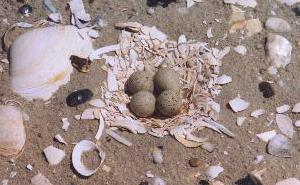
Plover beach nest

The exposed nature of the nests for many beach-nesting bird species make them particularly vulnerable to human intervention, both intentional and unintentional.