Tuesday, June 30, 2009

Invasive Flathead Catfish Found in NJ

Flathead Catfish
Pylodictus olivaris
Photo: Eric Engbretson, DOI, Fish and Wildlife Service, Invasive.org

The NJ DEP Division of Fish and Wildlife has verified a 5.5 pound, 20-inch Flathead Catfish was caught in the Delaware River at the Fireman’s Hole, Lambertville, on June 10, 2009. This is the third confirmed catch in New Jersey.

The first of these three Delaware River Flathead catfish was caught in 1999. It is believed that the fish originated from a reproducing population in the Schuylkill River in Pennsylvania.

Flathead catfish are native to a broad area west of the Appalachian Mountains encompassing the Mississippi, Missouri and Ohio River basins. They are an extremely predaceous catfish, reproducing and dispersing rapidly in river systems. Flathead catfish have been documented to eat substantial numbers of American shad during their spawning run. In the southeastern United States, the U.S. Fish and Wildlife Service has listed it as its highest priority among invasive animal species.

Flatheads can grow to a large size, and in warmer climates 90 to 100 pound fish have been documented. The body is yellowish brown to dark brown with black or brown mottling on lighter brown sides. It has a broadly flattened head and a tail that is only slightly indented, appearing more rounded or square. The key characteristic that helps anglers distinguish the flathead catfish from other catfish is that the lower jaw of the Flathead catfish projects past the upper jaw.

Anglers that catch what they think is a Flathead catfish are asked not to release it back into the water. A photograph of the fish is requested to confirm identification.

Notify the Division's Bureau of Freshwater Fisheries at:

Lebanon Field Office
1255 County Route 629
Lebanon, NJ 08833
908-236-2118 E-mail: mark.boriek@earthlink.net

Monday, June 29, 2009

NJ Wildlife Conservation Corps Volunteers

The Wildlife Conservation Corps (WCC), with more than 1700 members, is the largest natural resource management volunteer group in the state. I have been a member for more than 20 years.

WCC members are involved in all phases of activities from wildlife research and work in the field to helping with recordkeeping. Volunteers assist in many NJDEP activities including: the operation of deer, turkey, beaver and otter check stations; spring and fall trout stocking programs; operations at the Rockport Pheasant Farm; fishing instruction and visitor services at the Pequest facility; upkeep of five shooting ranges located in Wildlife Management Areas; and various activities with the Endangered and Nongame Species Program including the Speaker’s Bureau, presenting slide presentations on endangered and non-game species management.

Anyone 18 years of age and older is welcome to join the Division of Fish and Wildlife as a volunteer. If interested, check out these Frequently Asked Questions, complete and mail an application form (pdf, 22kb), or e-mail questions to WCC_DEP@dep.state.nj.us

Volunteers capture muskellunge and walleyes that washed over the Greenwood Lake Dam, so that Division employees can return them to the lake. Most of the fish would have fallen victim to infection in a few weeks due to lack of food supply and stress from warm water temperatures.

Thursday, June 25, 2009

A Swallow Tale

Swallow mud nests on a home under the roof soffit.

A story of good coming from bad from Patagonia's blog The Cleanest Line:

One of their Ventura, CA employees, Kim Stroud, is also the executive director of the nonprofit Ojai Raptor Center. Like other centers, they care for injured raptors and other birds and creatures (bobcats, fawns,coyotes).

Here's the bad part. A Ventura business decided to get rid of some messy swallow mud nests on their building. They hit them with hoses and washed out 55 baby swallows that were only about five days from being able to fly.

Kim got volunteers to take the swallows, feed them and then head out with volunteers to find other swallow nests in which they could try to "re-nest" the young birds.

When they found a nest (most likely out of reach of people), they needed to check inside to see who was inside. If there weren't too many babies there, they would add one. They found new nests for 32 birds.

That's a good thing, but that's what those people do all the time. Here's the other good part. The bad guys at that business decided to try to make amends. (Actually they are lucky that they didn't get hit with federal fines for breaking the Migratory Bird Act.) They are paying for all of the swallow rehab (including feeding), donating to the Ojai Raptor Center and are purchasing a lighted scope so the volunteers can see into those nests.

It's good that they appear to have learned a lesson, but it is a shame that they did what they did in the first place. To make things worse, the business (unnamed in the blog post), whatever it is, actually has wildlife biologists on staff. Unfortunately, a web search on swallow mud nests will turn up more sites telling you how to remove nests than ways to protect the birds.

Tuesday, June 23, 2009

Wildcat Ridge Wildlife Mangement Area


The Wildcat Ridge Wildlife Mangement Area, located off Rt. 513 in northern Morris County, features an official Hawk Migration Association of North America "hawkwatch" at the top of the ridge. This is a great place to see migrating hawks in the spring and fall as they ride the thermals along the ridge top.

The hawkwatch is staffed with NJDEP volunteers who perform the hawk counts from mid-August to mid-November, and in the spring from mid-February to mid-May. There is a viewing platform on the ridgetop.

The breathtaking view of the Highlands is well worth the walk to the lookout even when the hawks are not moving. The hawkwatch provides a spectacular vista of the forest and valleys of the Highlands. On a clear day the New York City skyline is visible from this overlook high on the edge of the ridge. The view provides an otherwise hard to obtain understanding of the vastness of the Highlands forest resource and its value to hundreds of species including humans, in northern New Jersey.

No other area in north Jersey has the large unfragmented forests needed to preserve populations of endangered hawks, owls, and increasingly rare songbirds. These forests are even more important to the millions of humans living in the urban centers whose drinking water comes from the lakes and streams of the Highlands purified by its forests and open space.

According to NJ Audubon, species of "Conservation Concern – State-endangered" at the Hawkwatch include the Northern Goshawk (seen in photo above) and Red-shouldered Hawk as well as the "Conservation Concern – State-special Concern" Cerulean Warbler.

A kiosk with information about the extensive trail network developed within this WMA, which includes a segment of the Highlands Trail, is located in the parking lot. A composting toilet is also available near the parking area.

Friday, June 19, 2009

Why Did the Amphibian Cross the Road?

Eastern Tiger Salamander (endangered in NJ)

Not only can you ask "Why Did the Amphibian Cross the Road?" but why would it try to cross a Jersey road?

In the article "Death by Rubber" on ScienceLine, they look at global amphibian declines and the scientists and volunteers who are trying to preserve backyard biodiversity.

That article looks at some volunteers on a wooded road in northwestern New Jersey, last March who were looking for frogs and salamanders to count. They wait for the amphibians to cross the road on their way from the wooded uplands where they winter to the marshy lowlands and vernal pools where they will do their spring mating.

Their night wasn't very successful and it's interesting that even experts are unsure what exactly triggers the spring migration. It might be rising ground temperatures, dropping barometric pressure and even the sound of the raindrops since the amphibians need the rain to stay moist and will need the vernal pools when they cross the road. In that case, they were hoping to see at least wood frogs and blue-spotted salamanders (pdf) which are more common amphibians in northern New Jersey and not endangered.

The NJDEP, Division of Fish and Wildlife’s Endangered and Nongame Species Program, the Conserve Wildlife Foundation of NJ, and the NJ Audubon Society are partners on the Amphibian Crossing Survey Project(pdf). They use volunteers to help us monitor sites in Warren and Morris County and to identify additional crossings throughout the northern region of the state. Due to limited resources, they are currently focusing efforts on northern New Jersey.

Seven years ago, volunteers had reported over 400 amphibians crossing the road in one night. Of course, crossing an NJ road has got to be a bit more hazardous than some other places and traffic has only increased in those 7 years.

It is estimated that one third of the world’s amphibians are threatened with extinction, according to the International Union for the Conservation of Nature (IUCN).

One habitat in Morris County, has probably lost its local population of blue-spotted salamanders which are an endangered species in the state, probably because of road kill during these crossings.

But roads also cause problems because of car exhaust, road salt & chemicals that leach into neighboring waterways and damage amphibian eggs and tadpoles and the simple fact that roads break large amphibian breeding groups into small, fragmented populations.

And NJ is not immune to other factors besides loss of suitable habitat. Even in safe areas, droughts and drier conditions have made these vernal pools disappear, perhaps due to climate change.


NJ Online Field Guide for Reptiles and Amphibians

Wednesday, June 17, 2009

NJ Wildlife Management Areas


New Jersey's Wildlife Management Area System, administered by the Division of Fish and Wildlife's Bureau of Land Management, preserves a diversity of fish and wildlife habitats from Delaware Bay coastal marshes to Kittatinny Ridge mountain tops.

The WMAs range in size from the 0.68 acre Delaware River Fishing Access Site at the Pennsauken WMA to the 30,000-acre Greenwood Forest Tract in Burlington and Ocean counties.

The areas provide outdoor recreational opportunities for New Jersey residents and visitors from out of state.

The purchase of the 387-acre Walpack Tract in Sussex County in 1932 marks the start of the system. The tract was purchased as a "Public Shooting and Fishing Ground" by the Board of Fish and Game Commissioners who were the forerunner of today's Fish and Game Council.
Part of the South Branch of the Raritan Wildlife Management Area

Today there are more than 324,000 acres in 120 areas which represents more than 44% of New Jersey's state-owned public open space.

The purchase of lands for the Wildlife Management Area System was initially funded entirely from the sale of hunting and fishing licenses, but, beginning in 1961, Green Acres bond issues have paid for about half of the present holdings.

The infusion of Green Acres monies has also broadened the mission of the Wildlife Management Area System from areas where fish and wildlife habitat is protected and enhanced, to providing a variety of compatible recreational and educational opportunities.

Tuesday, June 16, 2009

Endangered Piping Plovers in Sea Girt


The Sea Girt Borough Council voted this month to amend a beach use ordinance to ban kite flying and dog walking on the borough beach to protect endangered piping plovers who use the beach area to nest.

The ban would be in effect from March 15 to September 30 which certainly covers the entire summer tourist season.

It is another example of the difficult line between protection and economics that we walk in New Jersey. The ban would also include play with hard balls and Frisbees during bathing hours, and allows members of the beach patrol to designate certain areas for play with soft balls.

Sea Girt is making the change partly to protect itself from possible fines for violating the Endangered Species Act. They had already been fined in 2007 by the DEP $25,000 for raking an area of the beach near a plover nest. They were also fined by the U.S. Department of Fish and Wildlife at $28,000 fine for the death of a plover chick that he agency contended was killed by the beach rake. (Sea Girt is appealing the fines.)

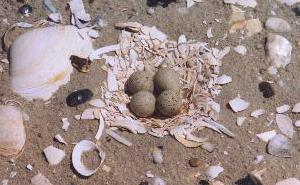
Plover beach nest

The exposed nature of the nests for many beach-nesting bird species make them particularly vulnerable to human intervention, both intentional and unintentional.

Monday, June 15, 2009

What is New Jersey's State Fruit?

Did you know that there are only three Native American fruits? They are the grape, bluebery and cranberry. All three grow in New Jersey.

New Jersey designated highbush blueberry (Vaccinium corymbosum) as the official state fruit in 2003.

In the legislative declaration, they give you a good little history of the fruit in our state. (I deleted the other "whereas" along the way.)

Whereas, the highbush blueberry is indigenous to New Jersey, where it was first cultivated for commercial production, due to pioneering work by New Jerseyan Elizabeth White and Dr. Frederick Covile, who in the early 1900's dedicated themselves to the study, domestication, and breeding of blueberries at Whitesbog, in Browns Mills, New Jersey; and

The cultivation of highbush blueberries in New Jersey served as the basis for an entirely new agricultural industry.

Highbush blueberries close-up photo by Kingsbrae Garden
on Flickr noncommercial use permitted with attribution / share alike

Blueberries taste good, are good for you, are high in fiber, vitamin C, and antioxidants, are sodium and cholesterol-free, are low in calories and provide medical and health benefits, including the prevention of cancer and heart disease.

They are appreciated around the world, especially in the area of nutrition and the emerging field of nutraceuticals, where blueberries are known for their health benefits and medicinal properties.

New Jersey ranks second in the nation in blueberry cultivation, producing 21% of the nation's total, with 38 million pounds grown annually on 8,000 acres, spanning seven counties in central and southern New Jersey. The state is widely recognized as the blueberry capital of the nation, and the highbush blueberry, also known as the "New Jersey blueberry," is the ideal symbol of a delicious, nutritious, and healthful fruit.

Sunday, June 14, 2009

Farmers' Markets

Residents of NJ know that farms in our "Garden State" (we are not the "farm state") are an endangered species.

So, it's great to know that there are 71 listings on Local Harvest's website for NJ.

Farmers' markets are one of the oldest forms of direct marketing by small farmers. In the last decade they have become a favorite marketing method for many farmers throughout the United States, and a weekly ritual for many shoppers.
In a farmers' market, a group of farmers sell their products once or twice a week at a designated public place like a park or parking lot. Some farmers' markets have live entertainment. Shopping at a farmers' market is a great way to meet local farmers and get fresh, flavorful produce.

You can search on their site by state or zip code for ones in your area.

Friday, June 12, 2009

NJ Bats Being Affected By Mysterious Disease

Several years ago, researchers began to report on a mysterious illness in the Northeast that is killing thousands of hibernating bats.

Wildlife officials are calling the illness “white nose syndrome” because the most obvious symptom is a white fungus that forms around the noses of some, but not all, of the afflicted bats.

Researchers do not yet know if the fungus actually causes death, but they have observed that bats with white nose syndrome deplete their fat reserves months before they would normally emerge from hibernation, and die as a result.

Experts have also advised the public to avoid entering any caves and mines that might harbor bats until more is known about the problem.

At that time, no evidence of disease was found among New Jersey’s wintering bat populations and it was feared that humans might carry this mysterious illness from one cave to another. Hikers, photographers and spelunkers are among those who frequent abandoned mines, caves and other locations that likely shelter hibernating bats.

Caves near Albany, N.Y., with up to 11,000 bats, proved to have more than 50% of the area’s wintering population. - were found dead, and many showed symptoms of the mysterious disease. The white fungus was found on bats hibernating in New York and southwest Vermont, and because bats migrate hundreds of miles to their summer range, the impact to other areas where hibernating bats could be significant.

The affected species include the Indiana bat, listed as endangered in New Jersey and nationwide. Wildlife experts report that little brown bats are sustaining the largest number of deaths, along with northern long-eared, eastern pipistrelle and other bat species using the same caves.

Now, the "white nose syndrome" has spread to NJ, according the New Jersey Division of Fish and Wildlife. The fungus was found on many of the dead bats found inside and outside three former mines in Rockaway Township and Denville, where the bulk of New Jersey's bat populations are found. This includes our largest bat hibernation spot (hibernaculum) at the Hibernia Mine.

The bats being impacted the most, at this point, appear to be the common little brown bat. Though the endangered Indiana bat has not been found with the disease, it is likely that species also will be impacted.

Bats that have developed the white fungus around their nose and wing membranes will take flight out of their caves when they should be hibernating during the winter months.

Hibernating bats are particularly vulnerable to disease or disturbance because they congregate in large numbers in caves and mines, forming tight clusters of 300 per square foot in some locations. Tens of thousands of bats hibernate in New Jersey in a small number of abandoned mines.

Thursday, June 11, 2009

Bats in New Jersey

Nine species of bats are considered regular residents of New Jersey. These include the little brown bat, big brown bat, northern long-eared bat, small-footed myotis, Eastern pipistrel, Indiana bat (state and federally endangered), hoary bat, red bat and silver-haired bat.


Endangered Indiana bat

The hoary, red and silver-haired bats are part-time residents that are found here from spring through fall when they migrate to southern states for the winter. The other six species remain here throughout the entire year and require special habitats for winter hibernation.

Natural caves once provided hibernating habitat for bats, but today most caves are subject to disturbance by people and thus are not suitable for use by bats. Abandoned mines and tunnels have replaced natural caves as the primary winter habitat for bats in many parts of the country because they are often unsafe to enter or inaccessible to people.

New Jersey's largest known bat hibernaculum is the Hibernia Mine in Rockaway Township, Morris County. The mine was abandoned in the early 1900s and the first record of bats using the mine is from the 1930s. In the decades that followed, the mine continued to provide winter habitat for bats but frequent and constant human disturbance limited the mine's potential.

Unsuccessful attempts were made by landowners to keep people out of the mine, but these efforts also made it unavailable to the bats. During the summer of 1994, the Endangered and Nongame Species Program negotiated an agreement with landowners to install a special bat conservation gate to keep people out but allow free access by the bats.

The state has also acquired the property through the Green Acres Program and it is currently part of the Wildcat Ridge Wildlife Management Area and is listed as a Watchable Wildlife Site.

The ENSP conducts a biennial winter survey to assess the bat population in the Hibernia Mine. A 1999 survey found a peak of more than 30,000 bats.

Starting in 2003, a Summer Bat Count has been done to map summer roosting locations throughout New Jersey.

New hibernacula have been located and protected including a tunnel in Worthington State Forest in Warren County.

Cooperating with the ENSP on these efforts are the Division of Parks and Forestry, the US Army Corps of Engineers, the US Fish and Wildlife Service and Bat Conservation International.

Wednesday, June 10, 2009

Mid-Atlantic Governors Agree To Protect Ocean Resources

Earlier this month, Gov. Jon Corzine signed an interstate agreement with other Mid-Atlantic governors to attempt to protect the Atlantic Ocean.

The main goal of the newly-formed Mid-Atlantic Regional Council on the Ocean will be to advocate for greater state influence with the federal government on the management of offshore waters.

"Ensuring the health of our ocean ecosystems and the resources they provide is paramount to Mid-Atlantic oceanfront states like New Jersey. Any threat to these natural resources brings economic consequences that threaten jobs, local economies, and our economic well being. New Jersey is committed to working with our Mid-Atlantic partners to provide adequate safeguards and formulate a shared vision for the region's future," said Corzine at the meeting.


tidal pool


New Jersey has 127 miles of Atlantic Ocean coastline and an additional 83 miles of shore along the Raritan and Delaware Bays.

Oddly enough, part of the agreement has the states collaborating on improving energy security and independence in the region through development of offshore renewable energy. Though that sounds anti-ocean protection, the plan is not for drilling but using the Outer Continental Shelf as a wind energy resource.

The agreement also has more obvious environmental aspects including increased protection of offshore habitats, climate change and sea level rise study, attempts to increase federal support for water quality infrastructure improvements and the reduction of marine debris.

The meeting included Corzine, NY Gov. David A. Paterson, representatives of the governors of Delaware, Maryland and Virginia, White House Council on Environmental Quality Chairwoman Nancy Sutley, National Oceanic & Atmospheric Administration Administrator Dr. Jane Lubchenco and actor/activist Sam Waterston.

Source: NEWJERSEYNEWSROOM.COM

Monday, June 8, 2009

Peregrine Falcons


I recently read online that the peregrine falcon is being removed from Iowa's endangered species list and it sent me back to check on the speies status in NJ.

Peregrine falcons (Falco peregrinus) are sometimes called an "indicator" species because they begin to vanish when pollution, over-hunting and other environmental factors encroach, an indicator of serious problems.

When the chemical DDT was widely used as a pesticide years ago, it turned out to be killing more than just bugs. Peregrines were nearly wiped out by DDT. The federal list was created in 1972 when DDT was banned nationwide and the Endangered Species Act was implemented.

Peregrine falcons were removed from the federal list in 1998, but remain on NJ's endangered species list.

Peregrine falcons are amazing. Like all falcon species, they are designed for speed. In a dive, peregrines can reach speeds of up to 200 M.P.H., making it the planet's fastest bird.

Traditionally, peregrine falcon nest sites were restricted to cliffs and rock outcrops, but as people began to inhabit areas occupied by peregrines, the birds took to nesting on buildings and bridges. In NJ, they continue to nest on these structures. There are no remaining cliff nests on the Hudson Palisades or the Delaware River in New Jersey. NJDEP has also built artificial nesting platforms in coastal marshes which are still active today.

It seems hard to believe today, but into the 1950s, egg collectors and falconers looted peregrine nests, while gunners, game wardens, and pigeon fanciers shot adult falcons, which were viewed as vermin.

DDT was heavily used in NJ for mosquito control and had a devastating effect on population declines for the peregrine falcon, osprey and bald eagle. Because these predators are high on the food chain, DDT had accumulated at levels that inhibited calcium metabolism which caused eggshell thinning in the birds. The resulting eggs cracked under the weight of the incubating adult.

By the 1960s, they were extirpated - there were no known nesting peregrines in the East.

DDT was banned in New Jersey in 1968 and in the United States in 1972. The peregrine falcon was classified as a federally endangered species in 1970 and as a New Jersey endangered species in 1974.

NJ biologists released young peregrines into the wild during the latter half of the 70s. This "hacking" was intended to reestablish nesting populations. Peregrines often return to their birth sites to breed.

The first releases in the traditional cliff sites unfortunately experienced high mortality due to great horned owl predation. The coastal man-made nesting structures were in locations where owl numbers were lower and prey was abundant.

The first nest site was at the Edwin B. Forsythe National Wildlife Refuge in Atlantic County. An analysis of eggshells from NJ nests still contained residual contaminants during the early 1980s, but were low enough that they shouldn't have impaired reproduction.

The peregrine had reached its NJ recovery goal of 10 pairs by 1986, and had stabilized at that level through the early 1990s.

Owl predation continued to be a problem for nests along the Delaware Bay and River. Unhatched eggs there and in the Barnegat and Manahawkin bays may have been a result of PCB contamination as well as DDE, chlordane, and dieldrin in the early 1990s.


Currently, the state’s peregrine population remains stable at about 15 pairs and exhibit good productivity, averaging 1.7 young per nest on buildings and towers since 1986.

Though the peregrine falcon was removed from the federal endangered species list in 1999, they continue to be listed as endangered in New Jersey because they remain threatened by environmental contaminants and human disturbance, and rely on active management of their nesting sites.

http://www.state.nj.us/dep/fgw/ensp/pdf/end-thrtened/peregrine.pdf

Friday, June 5, 2009

NJ's Two Free Fishing Days Are This Weekend

Residents and visitors can help themselves to free samples of the finest freshwater fishing found anywhere in the Northeast during New Jersey's Free Fishing Days on Saturday, June 6, and Sunday, June 7.

"On these two special days, anyone can fish anywhere in New Jersey without a license or trout stamp," Department of Environmental Protection Acting Commissioner Mark N. Mauriello said. "It's a perfect time for families and friends to discover the simple pleasures of fishing and enjoy quality time together in the outdoors. So if you haven't gone fishing in New Jersey lately, try it. We think you'll love it."

New Jersey offers every type of fishing for every level of angler. Cold, clear streams support a first-rate, year-round trout fishery. Waters statewide are teeming with trout now; just last week, the DEP's Division of Fish and Wildlife finished stocking some 600,000 trout, including more than 5,000 two-pound to five-pound fish.

Warmwater fishing in New Jersey is spectacular, too. During the past 20 years, the Division of Fish and Wildlife has developed thriving fisheries for a number of popular game fish, and now New Jersey anglers routinely catch world-class muskellunge and walleye as well as northern pike, channel catfish and hybrid striped bass. Outstanding statewide fisheries for largemouth and smallmouth bass, pickerel and many panfish species round out a wide array of warmwater fish available to New Jersey anglers.

Visit the DEP's Division of Fish and Wildlife Web site for a wealth of information on fishing in New Jersey, including where to fish for trout and various warmwater fish stocked statewide as well as how-to fishing tips for both beginners and advanced anglers.

NJ DEP news release: http://www.state.nj.us/dep/newsrel/2009/09_0012.htm

Wilderness Classrooms

An NOLS "classroom" - photo by Jeff Stein

I got the latest National Outdoor Leadership School catalog last week. It's one of those catalogs that I love to look through, even though I think I'm past the age of being able to do these courses.

Founded in 1965 by legendary mountaineer Paul Petzoldt, NOLS is a not-for-profit educational institution that takes people of all ages on remote wilderness expeditions.

They teach technical outdoor skills, leadership, and environmental ethics in some of the world’s wildest and most awe-inspiring classrooms.

The courses range from 10 days to a full academic year. It is a hands on, learn-by-doing approach that hopefully gives graduates skills to be competent, responsible wilderness travelers long after their course is over.


The Expedition from NOLS on Vimeo.

This is an informational video about their courses with footage from many different NOLS course areas, student and instructor testimonials, and a behind-the-scenes look at what an expedition is all about.

Wednesday, June 3, 2009

Sharing The Waters

Delaware River - via Trout Unlimited NJ State Council http://www.njtu.org/

Conservationists have argued for years that there has been environmental damage from mismanagement of the Delaware River. Back in 2007, a new plan for the river and its three reservoirs was adopted. The plan allows for releases of water from reservoirs into the Delaware River depending on the reservoir capacity and the season of the year.

Such a plan is necessary, but critics still believe it harms the river, its fish and
wildlife, and the communities that border it.

Wylie, an avid fisherman, wrote to me to say that he would like to see more posts about the environmental issues on the Delaware River System. (He attached the photo with a Delaware River brown trout.) He is particularly concerned about browns and the McCloud rainbow trout which he feels are threatened because of the policies concerning the releasing of water from New York reservoirs.

The Delaware River, which flows for hundreds of miles through Pennsylvania, New Jersey and New York, is home to many fish and wildlife species.

American shad are another interesting case. They travel hundreds of miles each spring from the Atlantic Ocean up the Delaware River, where they spawn. The Delaware is one of the only East Coast river ecosystems that supports a healthy, self-sustaining shad population.

Disagreements about how water is released from New York State reservoirs - which provide drinking water to New York City's five million residents - is long standing.

Of course, the river is also important for tourism in all three states, and a concern for residents who experience floods.

The problems with this "unnatural" release of water into river ecosystems is not unique here. A Web search will turn up plenty of ther cases with small and large rivers (like the Colorado River) around the world. Many of the problems stem from the inconsistency of the flow.

When the Delaware gets a surge of water flowed from the Catskill's Cannonsville reservoir into the West Branch of the Delaware River in New York State and then a week later it is cut down to just 5% percent of what it was just days before, you are going to do damage to an ecosystem. Not only the Delaware, but its tributaries get smaller and fish and wildlife habitat is compromised.

Back in April, the NJ Department of Environmental Protection cut back the amount of water being released from Lake Hopatcong from a high of more than 7 million gallons a day to about 4.2 million gallons by adjusting the gates on the dam

The state sometimes reduces flow to inspect dam structures, analyze aquatic vegetation and lakeshore structures for repairs.

In April, the concern was for businesses surrounding the lake that are concerned about the low water level hampering lake-related tourism.

On the environmental side, the DEP needs to take into account the needs of the downstream Lake Musconetcong, various trout streams and also a sewage treatment plant.

Springtime is a critical time for spawning fish, hatching insects and birds, all of whom would be negatively affected by fluctuations of the flow.

Our human engineering of water needs to be done in a way that acknowledges the needs of people and wildlife.